
How UTT Reviews Close Edge-Ball Calls
See what makes an edge ball in or out, how UTT’s TTR cameras review close contacts, what Season 7 evidence shows, and a 12-minute training drill.
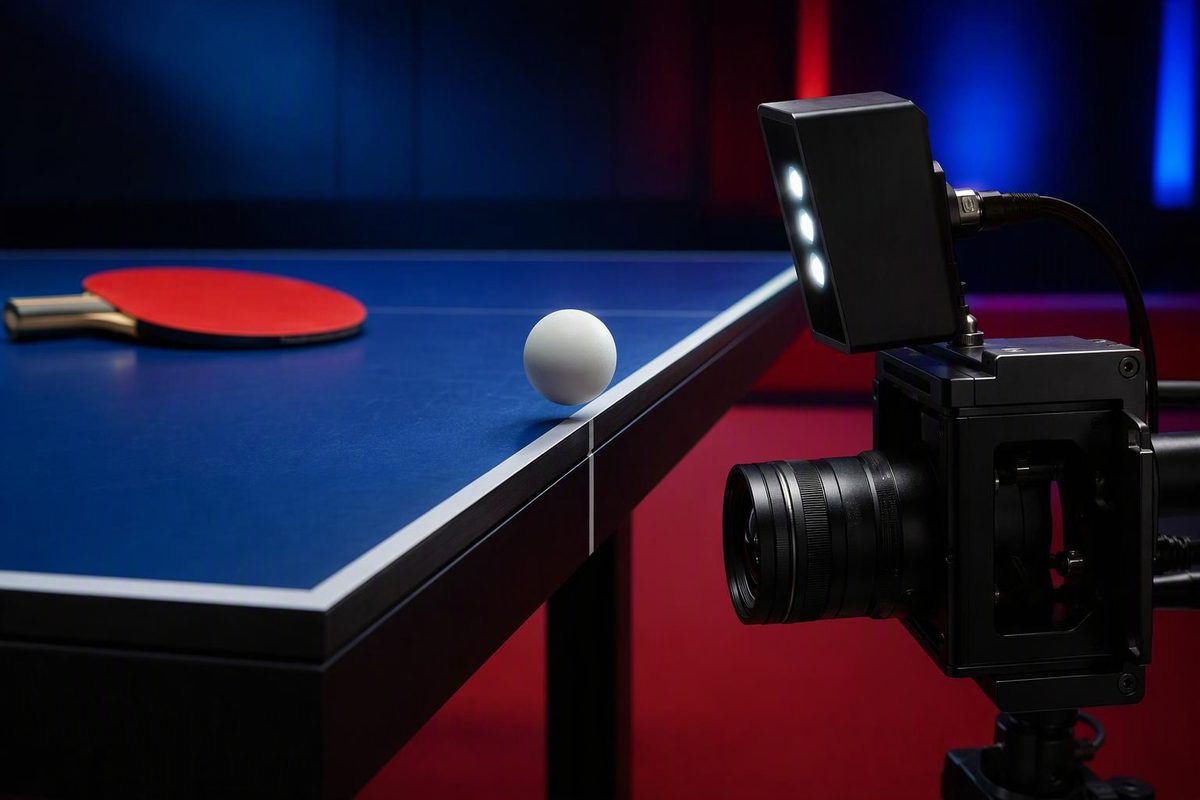
UTT’s Table Tennis Review system (TTR) helps officials judge edge-ball contacts; it does not change the rule. A ball that touches the top playing surface is in, including the white boundary line. A ball that touches only the vertical side is out. TTR provides additional camera views when that distinction is difficult to make at full speed.
Choose the surface the ball touched to see the correct ruling.
The ball touched the upper playing surface, so it touched the court. The white boundary line is part of that surface.
Edge-Ball Call Checker
Where did the ball make contact?
Rule: The upper surface is the playing surface; the vertical sides are excluded. An unclear view does not establish which surface was touched.
Source: 2026 ITTF Laws of Table Tennis, as reproduced by Table Tennis England. UTT challenge allowances are competition-specific.
The Top Surface Sets the Boundary
The distinction starts with the playing surface.
The 2026 laws define the playing surface as the table’s upper surface and specifically exclude the vertical sides of the tabletop. The white side and end lines belong to that upper surface. A return must touch the opponent’s court, either directly or after touching the net assembly (Table Tennis England’s reproduction of the 2026 ITTF laws).
That produces two different calls:
- Top edge: The ball clips any part of the upper playing surface, including a white boundary line. It is a valid table contact. If the opponent cannot return it, the player who struck the ball wins the point.
- Vertical side: The ball touches only the upright face below the playing surface. It has not touched the opponent’s court, so the player who struck it has failed to make a correct return and loses the point.
“Edge ball” can therefore be misleading. The question is not simply whether the ball touched the table near an edge. The official must determine whether any of the contact was on the top playing surface.
The same boundary applies during service. The ball must touch the server’s court and then the receiver’s court. A top-edge touch can satisfy that requirement, while contact only with a vertical side cannot.
UTT Uses Multiple Views Without Changing the Rule
Butterfly Ultimate Table Tennis introduced Stupa Sports’ version of TTR across Season 7 in Goa in July 2026. The announced setup used 14–15 synchronised high-speed cameras to capture ball trajectories, service actions and table-contact points from several views.
Table-edge calls were one of six review categories. The other five were service checks covering toss height, toss angle, the toss starting below the playing surface, the toss starting inside the end line and ball visibility (SportsMint’s report on the system announcement).
For a disputed edge call, the official still applies the ordinary top-versus-side rule. The technology supplies tracking data and footage from multiple cameras rather than creating a different standard.
A report from Season 7 says the UTT system created a 3D model and allowed the TTR official to inspect different angles and replay speeds before giving a verdict (Hindustan Times’ account from Season 7).
UTT Teams Received Three Reviews Per Match
Each UTT team received three reviews per match. A successful or inconclusive challenge was retained; an unsuccessful challenge cost one review.
The league’s account of the first TTR use in India shows that process in action. Manav Thakkar retained his allocation after two successful ball-visibility challenges, then lost a review when his third challenge was unsuccessful (Ultimate Table Tennis match report).
Those procedures are competition-specific. At the 2025 ITTF World Cup, for example, each player received two reviews per match, and the eligible decisions also included service nets and obstruction. As at UTT, successful and inconclusive challenges were retained (ITTF’s 2025 TTR overview).
Club players should not assume that UTT’s review allowance or eligible categories apply at another event. The underlying distinction between the upper playing surface and the vertical side remains the same, but challenge procedures depend on the competition.
Season 7 Evidence Was Encouraging but Incomplete
Multiple synchronised views give an official more evidence than a single real-time viewing position. They can also show players and spectators why a decision was made.
The early UTT reports were encouraging but incomplete. On July 17, midway through Season 7, the TTR referee said every challenge had produced a conclusive decision and that the system had experienced no technical glitches. However, almost 70% of the challenges concerned service angle rather than edge contact (Sportstar’s mid-tournament report).
The cited accounts did not provide a separate accuracy figure or average decision time for edge-ball reviews. It is therefore not possible to derive either figure from the available reporting.
There was also a difference between the launch claim and reported operating times. Pre-season material promoted verdicts in under 20 seconds. During the event, the TTR referee told Hindustan Times that height and angle reviews generally took 18–24 seconds, while hidden-service reviews took 40–49 seconds.
Those figures do not reveal how long a typical edge review took. They do show that “under 20 seconds” was not a ceiling for every challenge category.
The supported conclusion is narrower: UTT’s TTR can give the official additional evidence for a close edge call. The available mid-event reports do not establish a standalone accuracy rate for edge-ball decisions.
Train the Top-Versus-Side Decision in 12 Minutes
This drill requires a partner and a phone capable of recording slow-motion video. Choose either one side edge or one end edge.
Position the phone outside the playing area, level with and facing across that edge so the top and vertical surfaces are both visible. Protect it behind a barrier or place it on a tripod where no player can step into it or strike it during a swing.
Minutes 1–4: Make Immediate Calls
One player gently feeds balls toward the chosen edge. The observer calls “top,” “side” or “unclear” immediately after each contact.
The purpose is to make the decision from the relevant surface rather than from the general direction of the rebound.
Minutes 5–8: Check the Visible Contact
Review the doubtful contacts in slow motion. Look for visible contact with the upper surface. Do not decide from sound alone, and mark the result “unclear” when the camera angle is blocked.
Only count clips in which the contact surface is visible. A recording that fails to show the contact cannot confirm a top-edge or vertical-side call.
Minutes 9–12: Add Game Speed
Play points using the half of the table nearest the camera. Record disputed edge calls, but review them only after every five points so the drill keeps moving.
Aim to identify eight out of ten visible contacts correctly in two consecutive sets before increasing the feed speed or moving the camera to another edge.
A single phone is not TTR and cannot settle every contact. Its training value is narrower: learning to identify the relevant surface, make a prompt call and accept “unclear” when the available view does not show enough.