
Turn a Short Dead Ball Into a Controlled First Attack
Attack when it is short, reachable and met on time; otherwise push. Build control through realistic feeds, placement, spin variation and recovery.
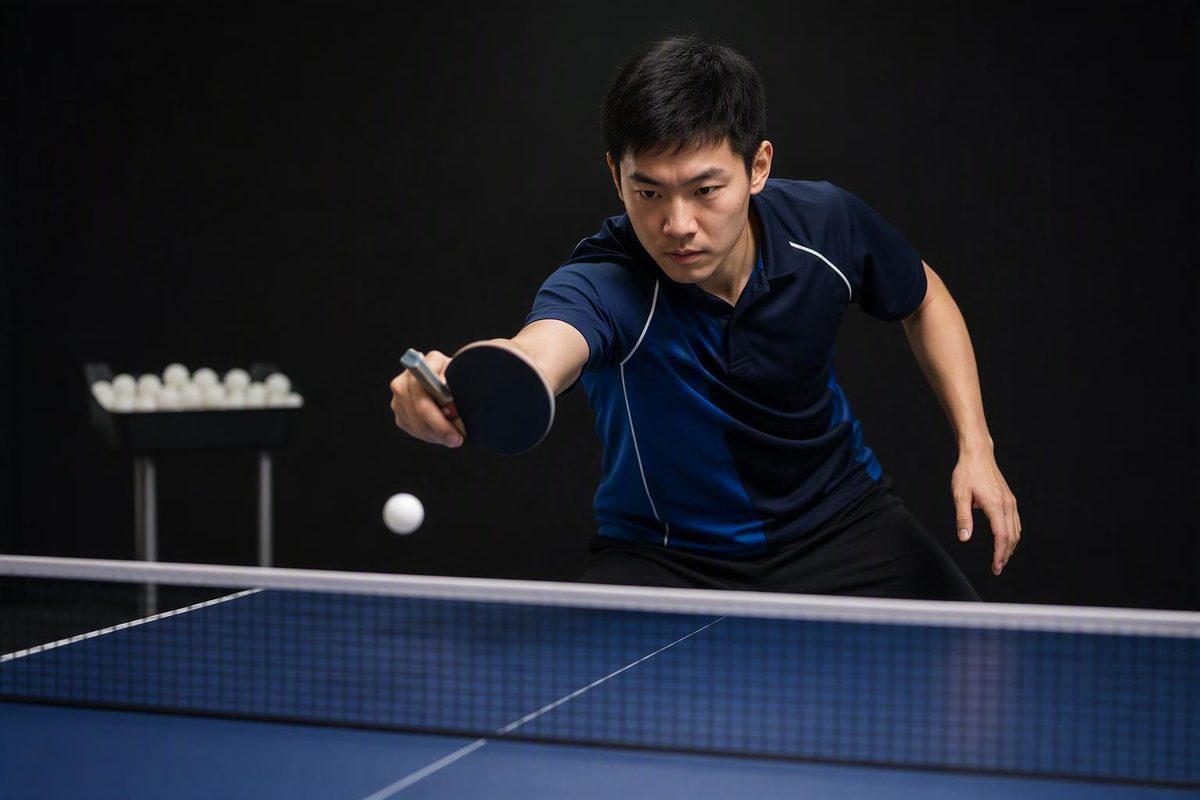
Yes—a forehand flick, also called a forehand flip, is a viable attacking return when a no-spin or dead ball lands short over the forehand side. Choose it when the ball is reachable, you arrive on time, and you are reasonably confident about the spin. The shot does not need to win the point outright: its purpose can be to establish the first attack while leaving you balanced for the next ball.
The short answer: flick the right no-spin ball
This article addresses a short no-spin ball over the forehand side, typically in serve receive or a short-feed drill. It does not address a fast, deep backspin push or return, which is a different playing situation.
Some players report difficulty generating pace and maintaining control against dead balls, although that player discussion is anecdotal and does not establish how common the problem is.
Other players describe low-spin balls as comparatively manageable, particularly when contrasted with heavy backspin. These experiences are not necessarily contradictory. The important question is whether you can produce a controlled attacking return from the ball in front of you.
Use a simple baseline approach: arrive in balance, choose a clear target, make a controlled attacking attempt, and recover immediately. Exact racket angle, contact point, timing, and swing direction will vary with the ball’s height, your position, your equipment, and the intended placement.
Use a flick-or-push decision table
Do not flick every ball merely because it lands short. Height, reach, timing, placement, and confidence in the spin read interact; no single factor decides the return by itself.
| Favor the forehand flick | Favor the push |
|---|---|
| The ball is short and reachable without excessive leaning. | The ball is extremely low or difficult to reach cleanly. |
| You arrive early enough to establish balance. | You arrive late and would have to improvise. |
| The contact height offers a workable attacking opportunity. | The height leaves little margin for an attacking return. |
| You are reasonably confident that the ball is no spin or only lightly cut. | The spin is uncertain, disguised, or stronger than expected. |
| You can place the ball and recover for the next shot. | Flicking would leave you stretched or unable to recover. |
Treat these as risk-assessment factors rather than rigid laws. A lower ball may still be attackable when you read it early and reach it in balance. An inviting-looking ball may still deserve a push when your position or spin read is poor.
Choosing to push a difficult feed is sound shot selection, not a failure to attack. Attack when you have a credible opportunity; otherwise, use the return that gives you the best chance of controlling the point.
Separate no spin from heavy backspin
Identify both length and spin before choosing the return. A short genuine no-spin serve, an uncertain light-backspin serve, and a short heavy-backspin serve are not interchangeable.
| Incoming ball | Main challenge | Practical response |
|---|---|---|
| Genuine no spin | Creating outgoing pace and spin while controlling the return | Attempt a controlled attack when the ball is reachable and met on time. |
| Uncertain no spin or light backspin | Managing the risk of an incorrect spin read | Reduce ambition, prioritize placement, or push when confidence is low. |
| Heavy backspin | Adapting to a meaningfully different incoming ball | Test a suitable adjustment rather than copying the no-spin action automatically. |
The available evidence does not establish one authoritative racket angle, contact point, contact timing, or forward-to-upward swing ratio for a genuine no-spin ball. Those details can vary with height, position, equipment, movement, and tactical intention.
In a MyTableTennis.NET discussion of the forehand flick, contributors associate heavy backspin with greater upward action and contact near or just after the peak. Treat that as anecdotal guidance to test rather than a universal coaching rule.
Do not transfer an adjustment for heavy backspin mechanically to a genuinely dead ball. Read the actual serve, make a measured choice, and evaluate the resulting return instead of assuming that one action fits every short ball.
Diagnose control and pace as separate problems
“Weak” and “inconsistent” are different complaints. First determine whether you are struggling to produce a useful attacking ball or struggling to control where it goes.
Use a simple practice log:
| Outcome | What to record | Next test |
|---|---|---|
| Net | Feed height, arrival time, spin read, and intended target | Change one selected variable during the next group of feeds. |
| Long | Contact height, target, and effort level | Test one small adjustment while keeping the feed stable. |
| High | Whether the return was controlled and where it landed | Compare one alternative without changing several variables together. |
| Weak | Whether the ball lacked pace, spin, depth, or placement | Test contact quality or effort while preserving control. |
| Late | Starting position, first movement, balance, and reach | Prioritize earlier arrival before redesigning the stroke. |
These outcomes are observations, not diagnoses. A ball in the net does not prove one particular racket-angle error, and a long ball does not establish one universal correction. Feed quality, spin recognition, timing, contact, placement, and effort may all be relevant.
Change only one variable at a time, such as:
- arrival time;
- racket angle;
- swing direction;
- contact quality;
- target;
- effort level.
Keep the feed as stable as possible and record the result. Start with a controlled return to a defined target. Add pace only after you can reproduce the basic attacking outcome, rather than trying to make every early attempt a winner.
Build the shot with a progressive partner drill
Develop the flick by adding one source of uncertainty at a time. Larry Hodges likewise presents forehand-flip development as a progression involving different spins, placements, random feeds, and recovery.
- Predictable short no-spin feeds: Ask a partner to feed low, short no-spin balls to one comfortable forehand location. Aim for controlled placement and immediate recovery.
- Varied forehand-side placement: Keep the spin predictable but move the feed around the short forehand area. Use your feet to reach each ball rather than relying on a fixed stance.
- Mixed short placements: Add feeds toward the middle. Decide whether each ball is genuinely suitable for a forehand flick instead of forcing the stroke.
- No spin mixed with light backspin: Use similar-looking feeds with different spin. The task is to read the ball and select an appropriate return, not to repeat an identical action.
- Random feeds: Vary placement, spin, and predictability. Permit both flicks and pushes so that the drill tests shot selection.
- Add a follow-up ball: After each flick, the feeder sends another ball—first to a known location and later to a variable one. Recover and play the continuation.
Do not advance according to an invented repetition count or success percentage. Add difficulty when you can preserve a controlled attacking return, purposeful placement, and balanced recovery at the current stage. If a new variable causes all three to collapse, simplify the feed and rebuild.
Do not stop to watch the flick. Recover as soon as the action is complete and expect another ball. This makes the stroke the opening of an attacking sequence rather than a one-shot gamble.
Check whether the feed is realistic
A drill is useful only when the feed resembles the ball you intend to receive. Check that it lands short, stays low, and arrives with the intended amount of spin.
One contributor in the MyTableTennis.NET discussion preferred partner practice because their robot delivered the ball too high to reproduce a low serve. That was one player’s experience, not evidence that partner practice is universally superior. A robot may still provide valuable repetition if it can recreate the required height, length, placement, and spin.
Before treating robot success as match-ready performance, ask:
- Does the ball stay low enough to create a realistic decision?
- Does it land short enough to require movement over the table?
- Can the machine reproduce no spin and introduce light backspin?
- Can you vary placement without turning the exercise into a deep-ball drill?
- Are you recovering after every return rather than resetting casually?
Ask the feeder to prioritize repeatability at first, then introduce disguise and variation deliberately.
Solo, partner, and robot formats can all contribute to structured practice. Ping Pong King describes its broader training focus as including serves, footwork, and practice design across solo, partner, and robot settings. For this drill, choose the format that can reproduce the intended ball and support the next stage of progression.
Frequently asked questions
Are a forehand flick and a forehand flip the same stroke?
Usually, yes. Terminology varies between players and coaching traditions, so focus on the situation and intended return rather than the label.
Does a forehand flick against no spin need to be a winner?
No. It can simply establish the first attack. Judge the shot by whether it produces a controlled, purposeful return and leaves you ready for the next ball—not only by whether it ends the point.
The practical match rule is straightforward: flick when the no-spin ball is short, reachable, and met on time; push when it is too low, late, or uncertain. Develop the attack through realistic feeds, controlled placement, increasing variation, and recovery—not by chasing one universal racket-angle formula or trying to finish every point immediately.