
Build a Forehand Topspin You Can Repeat
Learn forehand topspin technique against a block, adjust for backspin, and test contact, placement and recovery in a 20-minute partner or robot session.
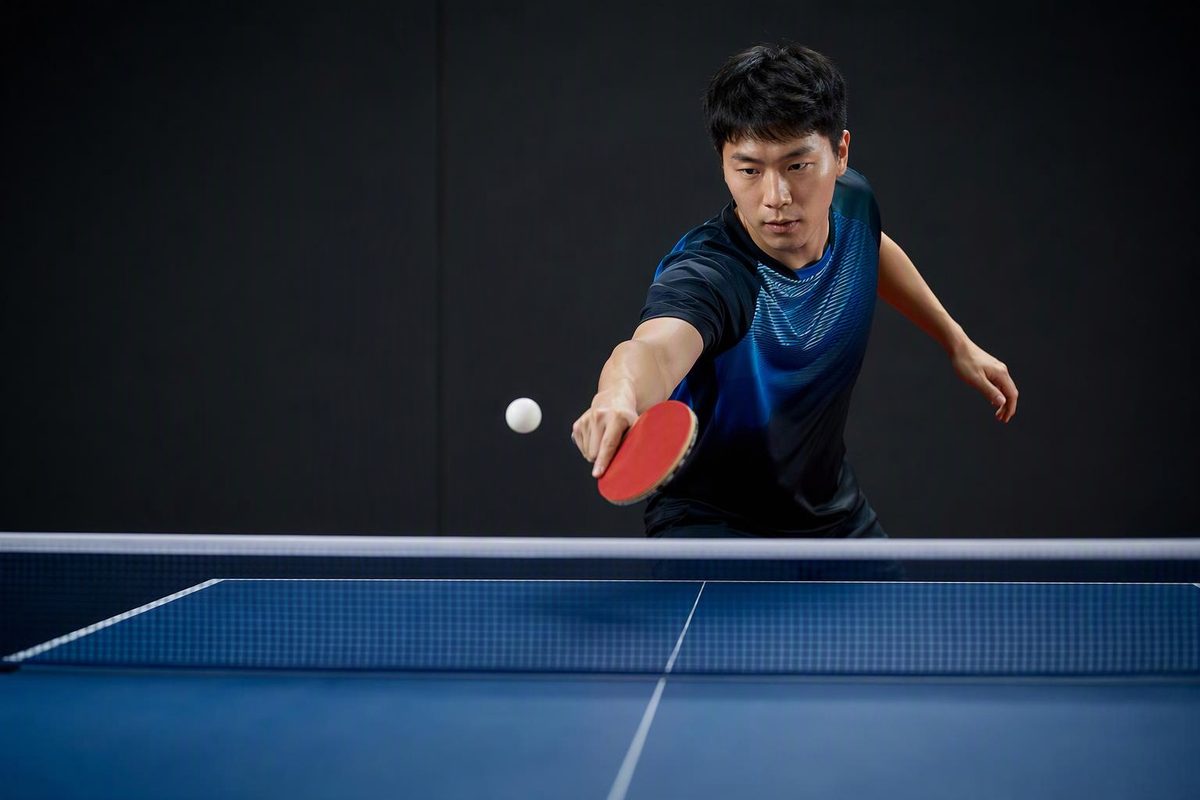
A repeatable forehand topspin needs more than an upward swing: get into position, brush the ball in front of you, then recover before the next return. Start against a steady block rather than trying to hit winners.
Setup: a table, bat, balls and a partner who can block consistently, or a robot feeding light topspin. The session below takes 20 minutes after your usual physical warm-up and focuses on close-to-table topspin. Timings include brief pauses and ball collection, with one player attacking; repeat with roles reversed if both players want a turn. Instructions assume a right-handed player; left-handers should reverse the sides.
Build the stroke against a block
A block is a compact return that uses much of the incoming ball’s pace. It can come back quickly, so your preparation and recovery must fit the time available.
1. Make room before you swing
Start with knees comfortably bent, feet apart and your right foot slightly behind your left. Keep the bat in front of you between shots. Adjust your feet so the ball will arrive in front of your right side, not directly at your stomach.
Turn your waist slightly to the right and take the bat back around waist height. Keep the wrist relaxed. Avoid dropping the bat far below the table for a routine topspin return.
Checkpoint: you can swing without squeezing your elbow against your body or reaching sideways at full stretch.
2. Brush forward and up
Turn forward and accelerate the bat forward and upward. Keep the face closed—its top edge tilted forward—and brush towards the top of the ball rather than striking squarely through its centre.
For this close-to-table drill, meet the ball near the peak of its bounce, just in front of you and to your right. Against a block, the swing is more forward than the lifting action used against backspin. These preparation, contact and swing cues follow Tom Lodziak’s forehand topspin guidance.
Use a moderate pace that your partner can return. Brushing does not mean barely touching the ball: aim for a grippy contact that sends it forward with spin.
3. Finish, then reset
Let the bat finish in front of your face without wrapping far behind your left shoulder. Bring it back to ready position and rebalance immediately. Table Tennis England’s forehand coaching guide likewise emphasises forward-and-upward follow-through and recovery to ready position.
Use your body turn rather than making the arm do all the work. Lodziak’s five-stage forehand progression develops contact first, then waist rotation, leg power, placement and spin variation. Follow that order rather than adding power before you can repeat the contact.
Checkpoint: when the partner blocks, your bat is already returning to ready position—not still completing the previous swing.
Change the swing when the spin changes
Do not use the same lifting stroke for every ball.
- Against a routine block: start around waist height, keep the face closed and swing forward and up.
- Against long backspin: start lower, bend your knees and accelerate more upward to lift the ball over the net. Contact remains in front of the body. Generally use a less closed face than against a block, adjusting to the amount of backspin rather than adopting one fixed angle.
The lower preparation and upward brushing action are explained in Lodziak’s backspin coaching guide; Table Tennis England explains the spin-dependent racket-angle adjustment. For a dedicated opening-attack session, use the forehand loop against backspin practice.
A 20-minute contact-and-recovery session
Agree on your partner’s stronger blocking half as the landing target, leaving room inside the edges. Ask for steady blocks to your forehand, not difficult changes of spin. With a robot, use a fixed light-topspin feed and a frequency that lets you reset between balls.
Minutes 0–3: find a controllable pace
Rally gently, gradually adding brushing contact. Keep the target broad. If you must rush or reach, slow the feed or ask your partner for easier returns.
Minutes 3–10: repeat one contact
Work in sets of 10 topspin attempts. Count balls landing in the target, then take a short pause. Aim for seven out of 10 as a practice goal, not a performance standard.
Choose just one cue per set: “contact in front,” “forward and up,” or “reset.” If the rally breaks, restart with an easy feed; do not count the setup ball. Count your own misses, but exclude feeds outside the agreed area. A partner’s missed block does not erase a successful shot or count as your next attempt.
Minutes 10–16: add a small foot adjustment
Ask for alternating blocks to two nearby positions within your forehand court. Move your feet before swinging and send both balls to the same target. Use two-position feeds if your robot supports them; otherwise retain the fixed feed and focus on recovery.
Count a successful pair only when both shots land in the target and you regain balance between them. If the partner cannot return the first shot to the agreed second position, the pair is untested; restart it.
Minutes 16–20: test without reminders
Return to the fixed feed and play up to three sets of 10. Record target hits and any shots where you were late to reset. If time runs out, record the actual number of attempts. Compare equal-sized sets with the earlier work before increasing pace next session.
Fix one miss pattern at a time
PingSkills identifies late contact, flat contact and a low follow-through as common forehand topspin errors. Use those as checks, not automatic diagnoses:
| What you notice | First adjustment to test |
|---|---|
| Ball repeatedly goes long against blocks | Check whether the bat starts too low; reduce excessive lift. |
| Ball repeatedly hits the net | Check for flat contact or a low finish; add a clearer upward brushing component. |
| Contact happens beside or behind your hip | Prepare earlier and slow the feed until you can meet it in front. |
| First shot works, next shot is rushed | Shorten the backswing and finish; prioritise the reset. |
Keep the feed unchanged while testing an adjustment. Once contact and recovery hold up, progress to the longer forehand loop drill session rather than simply swinging harder.