
4 Forehand Loop Drills for Spin, Footwork and Recovery
Train forehand loops with a 40-minute partner session: controlled rallies, two-point footwork, opening attacks and random blocks, plus robot options.
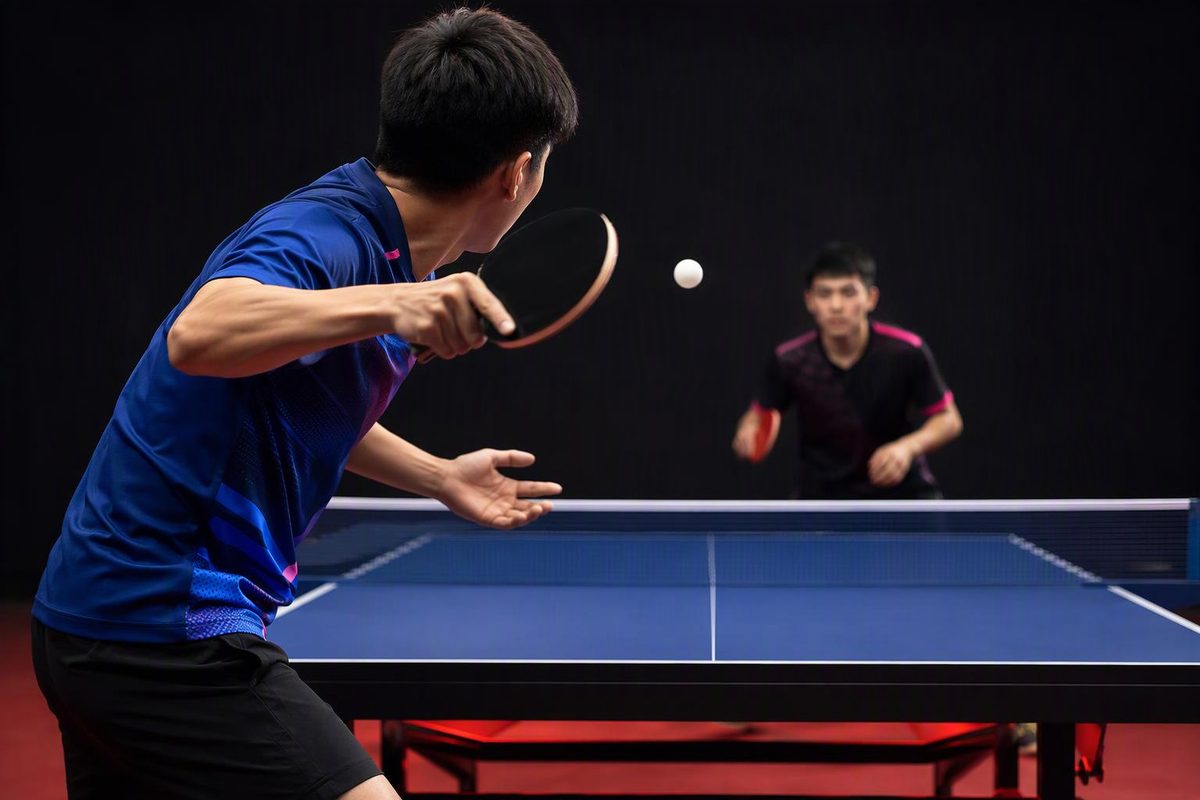
Use these four forehand loop drills to practise more than landing the first attack: place the ball, move into position and prepare for the next return.
Main setup: a partner who can block and push, a table and several balls. The 40-minute schedule gives both players attacking turns. Robot and solo adaptations are below.
A loop is a topspin attack made with a brushing contact. Start at a controlled pace—not winner speed—and use generous targets such as an entire half of the table. The checkpoints below are suggested practice targets, not performance standards.
Before the drills: 4 minutes
After your usual physical warm-up, spend two minutes exchanging easy forehand drives, then two minutes looping gently against a steady block, taking a minute each as attacker. A block is a compact return that uses the incoming ball’s pace.
For looping against a block, prepare the racket around waist height with its face tilted forward, rotate through the waist and brush forward and upward. Contact the ball in front and to the side of your body. Close to the table, keep the stroke compact and aim to contact around the bounce peak. These cues follow coach Tom Lodziak’s forehand topspin against block guidance.
Finish each stroke by bringing the racket back into readiness. If you are still holding the finish when your partner contacts the ball, slow the rally.
1. Fixed-position loop against block — 8 minutes
Setup: Your partner blocks to one comfortable position in your forehand court. Send every loop to their stronger blocking side; agree on that target before starting.
Action: Loop at a pace your partner can return reliably. Begin with three consecutive loops, reset, then build toward five. Resist speeding up after the first good shot.
Use roughly 45 seconds of practice followed by 15 seconds to reset or collect balls. Swap attacker and blocker after four minutes; use the same timing for the next three drills.
Checkpoint: Complete three rallies containing five consecutive loops each. Watch for a brushing contact and a ready racket before every return—not just balls landing on the table.
If the blocker repeatedly misses, reduce pace or enlarge your target. A partner’s missed block is not evidence that your next-ball recovery is sound.
2. Two-point forehand loops — 8 minutes
Setup: Your partner alternates blocks between your wide forehand and a second position nearer the middle. Start with a small gap that you can cover without reaching. Keep your outgoing target fixed.
Action: Use small lateral steps to create room beside the ball, loop, then move for the next return. Do not plant yourself wide and stretch an arm toward the middle ball.
Keep your turn compact. PingSkills coach Alois Rosario advises using waist rotation when time is short rather than trying to turn fully side-on for every forehand; see his answer on forehand loops and footwork.
Checkpoint: Complete three sequences of four loops—wide, middle, wide, middle—with balanced contact on each. Only then widen the feed positions. If you stumble or repeatedly get crowded by the ball, narrow the gap or slow the feed.
3. Open against backspin, then loop the block — 8 minutes
Setup: Serve backspin. Your partner pushes long to your forehand, then blocks your opening loop back to the same area. A long push is one that would leave your end of the table before bouncing a second time.
Action: Play a controlled opening loop to the agreed blocking target, recover immediately and loop the following block to that target. Stop after the second attack and restart.
The two balls need different preparation: brush more upward against the backspin push, then use a more forward stroke and a more closed racket face against the block. Expert Table Tennis’s open-up and topspin multiball drill rehearses this spin change using alternating backspin and topspin feeds.
Checkpoint: In a batch of ten testable starts, aim to land both attacks in at least six. Count an opening-loop miss, but replay an unsuitable push. If your opener lands and your partner misses the block or sends it outside the agreed area, mark the follow-up as untested and replay the start for the pair count.
Record opening-loop misses separately from second-loop misses. If the opener lands but the second ball flies long, check whether you kept the same low preparation and upward swing for both shots.
For a fuller technique session, use forehand loop against backspin.
4. Random blocks within the forehand half — 8 minutes
Setup: Return every loop to your partner’s agreed blocking target. They may now block anywhere within your forehand half, including repeating the same position. Keep the speed manageable.
Action: Watch the partner’s racket and ball, then adjust your feet. Do not begin moving toward an assumed next location. Start with three-loop rallies before trying longer ones.
Limiting random placement to the forehand half is one of the options described in Expert Table Tennis’s random-drill coaching guidance.
Checkpoint: Across ten rallies, count how many reach three loops. Also note whether misses follow reaching, crowding or late recovery. If randomness makes the stroke collapse, reduce the placement range—not just the scoring target.
Final check — 4 minutes
Take two minutes each to repeat drill 3, without technical reminders between balls. Use the same counting rules and aim for ten testable starts; record the actual number if time runs out.
Record:
- Opening loops landed out of the counted starts.
- Starts with both attacks landed.
- The most frequent miss: net, long or poor positioning.
Repeat this check next session with the same partner, target and approximate pace, comparing equal-sized batches. Use the result to choose which drill gets extra time.
Robot or solo options
Robot: Replace the block in drills 1, 2 and 4 with a low, manageable topspin feed. Use fixed placement first, then alternating or random positions if your machine supports them. For drill 3, alternate backspin and topspin only if the robot can change spin between balls. This rehearses the stroke adjustment, not the actual serve–push–loop–block exchange. Otherwise train those strokes in separate sets; that does not reproduce the opening-loop-to-block transition.
Solo without a robot: Shadow the two-point footwork: move, swing, recover, then move again. Use five sets of 30 seconds with equal rest, checking balance and racket recovery. Treat this as movement rehearsal, not a test of spin or contact quality.