
Build a Forehand Attack You Can Recover From
Choose the right forehand attack, adjust for backspin and practise placement, movement and recovery in a 35-minute partner session, with robot options.
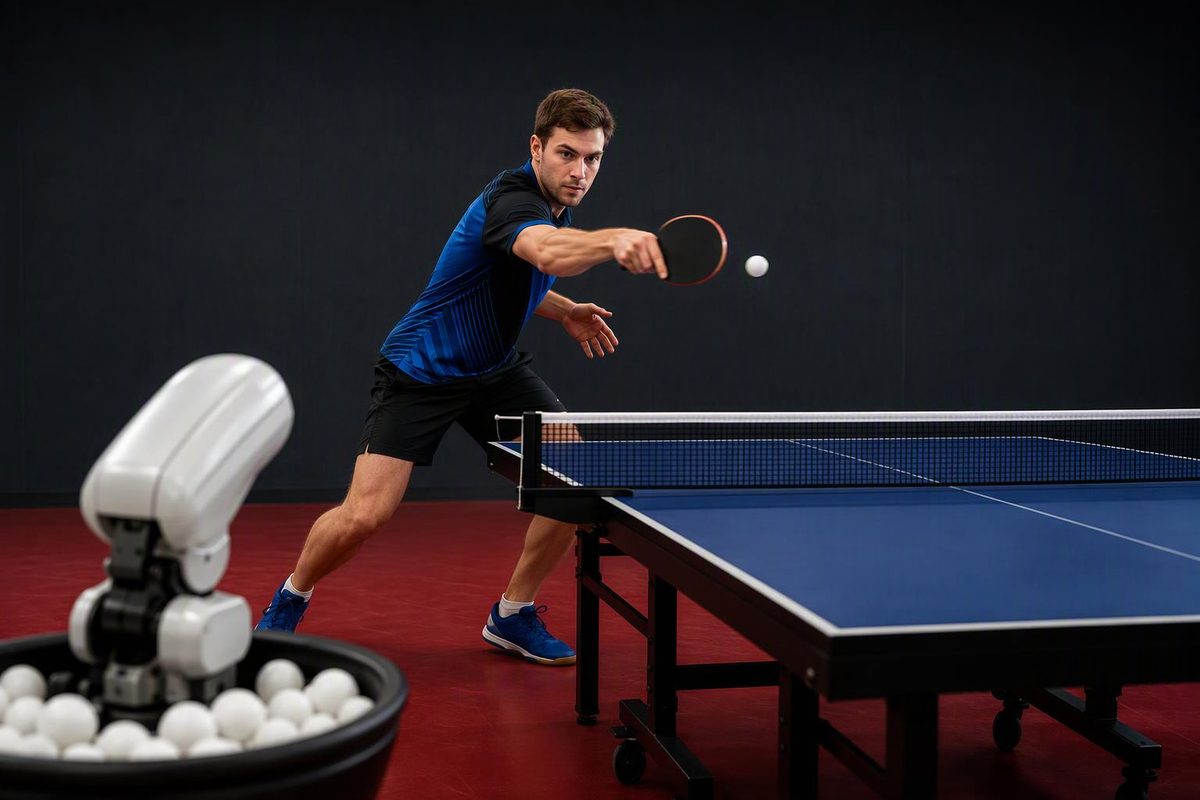
A useful forehand attack is not just a hard shot. It is a shot you can place, recover from and follow with another ball. Start by separating two actions: a compact drive against a manageable topspin or no-spin ball, and a brushing topspin opening against backspin.
This 35-minute session trains both, then adds movement and a serve-and-attack pattern. You need a partner and a basket of balls. A robot can cover the fixed-feed work; adaptations are below. The timings include brief resets and ball collection and are for one designated attacker—split the blocks equally if both players need a turn.
Choose the stroke before you swing
| Incoming ball | Starting choice for this session |
|---|---|
| Long, moderate topspin or no spin; comfortable height | Compact forehand drive or controlled topspin |
| Long backspin; enough space and preparation time | Forehand topspin opening, often called a loop |
| Short and low, likely to bounce twice on your side | Push rather than force a full swing |
| Fast, heavy topspin that leaves little time | Shorten the action and block rather than force an attack |
The basic drive is intended for medium-length or long topspin and no-spin balls—not a short ball or a backspin opening. Expert Table Tennis’s forehand-drive guide makes this distinction. Against a strong attack, a block uses a shorter action and the incoming ball’s pace, as described in Table Tennis England’s forehand coaching guide.
Short-ball attacking is a separate skill: see when and how to forehand flick a no-spin ball.
Three technique checkpoints
The directions below are for a right-hander; reverse left and right if you are left-handed.
1. Make room with your feet. Start with bent knees, feet slightly wider than shoulder width and the right foot slightly behind the left. Keep a small gap between your elbow and body. Move so the ball is comfortably in front of you, rather than trapped beside your hip.
2. Let the body turn support the stroke. For a drive, make a small turn to the right, then rotate forward with a modest weight transfer from right foot to left. Use a slightly closed racket face—the top edge tilted forward—and meet the ball near the peak of its bounce. Finish forward and upward, without wrapping the racket around your neck. These are core cues in Expert Table Tennis’s technique breakdown.
3. Change the action for backspin. Compared with topspin against a block, start the racket lower, use a less closed face and brush more upward on the back of the ball, contacting near the bounce peak or just after. The adjustment depends on the amount of backspin; copying the same lifting action onto a no-spin ball can send it long. Table Tennis England explains this spin-dependent change and recommends developing sound basic topspin technique before attempting this opening.
After either stroke, return the racket in front and regain a balanced ready position. Recovery is part of the repetition, not something to add once the attack works.
The 35-minute session
Warm up physically before starting. Choose the opponent’s backhand half as your initial landing target, staying comfortably inside the edges. Use these checkpoints as practice goals, not rating benchmarks. If you cannot yet sustain a gentle drive rally, stay with the first two blocks before adding backspin openings.
1. Find a repeatable contact — 5 minutes
Your partner blocks gently to your forehand. Play compact drives crosscourt for the first two minutes, then direct them to the chosen target for the remaining three.
Work at a pace where both players can sustain the rally. Between rallies, check one cue only: contact in front, body rotation or a compact finish.
Checkpoint: Count ten consecutive attempts. Aim for eight on the table before increasing pace. If that is difficult, make the feed slower and more predictable.
2. Add two-position movement — 8 minutes
Your partner alternates balls between your forehand side and the middle of your half. Play a forehand from both positions, directing each shot to the same target.
Start with a narrow distance between feeds. Move sideways to make space for the middle ball rather than squeezing your elbow against your body. Expand the distance only when you can recover without stumbling or reaching.
This follows the forehand-and-middle pattern described in Tom Lodziak’s two-position drill.
Checkpoint: Complete five clean two-ball sequences. A sequence counts only when both shots land and you are ready for the next feed.
3. Open against backspin, then play again — 10 minutes
For five minutes, your partner feeds a predictable long backspin ball to your forehand. Open with controlled topspin into the target. Prioritise a repeatable arc and placement over maximum speed.
For the next five minutes, use this rally pattern:
- Serve short backspin.
- Your partner pushes long to your forehand.
- Open with forehand topspin.
- Your partner blocks back to your forehand.
- Play a controlled follow-up attack.
Do not repeat the opening’s more upward action automatically on the block: the incoming spin has changed. If you cannot reliably start this pattern, continue with predictable backspin feeds instead.
Checkpoint: Count ten starts. Record successful openings and successful opening-plus-follow-up pairs separately. This reveals whether the problem is the first attack or what happens afterward.
4. Test the decision — 12 minutes
Keep the same serve, but let your partner choose between a short push and a long push to your forehand. Push the short ball; attack the long one when you have room and balance. Then play the point freely.
Ask for clearly short or clearly long returns initially, rather than ambiguous half-long balls.
Checkpoint: Over ten points, record:
- Correct short-versus-long decisions.
- Long-ball attacks landing in the target.
- Attacks after which you were ready for the next ball.
Winning the point is separate from executing the task. A missed winner should not erase a good decision, and a lucky edge should not hide poor recovery.
Robot options and quick corrections
With a robot, use fixed moderate topspin or no-spin feeds for block 1 and alternating forehand/middle feeds for block 2, if supported. For block 3, practise backspin openings separately from topspin follow-ups unless the robot can produce the required sequence. Save the serve-return decision test for a partner; a predictable feed does not test reading an opponent’s return.
- Opening keeps hitting the net: Check that you recognised backspin, had room and brushed upward rather than driving flat.
- Opening flies long on lighter spin: Reduce the lift and adjust the racket face; do not treat every push as heavy backspin.
- First attack lands, next ball is missed: Reduce pace and shorten the finish until recovery becomes repeatable.
- Middle feeds feel cramped: Narrow the feed spacing and rehearse the sideways adjustment before adding speed.
Write down the three final checkpoint counts. Next session, repeat the same setup and change only one demand—feed spacing, placement or pace—rather than making everything harder at once.