
Create Space, Shorten the Stroke, and Choose the Return You Can Control
Recover promptly, judge your room, balance, and preparation time, then adjust your feet or shorten preparation rather than forcing a full swing.
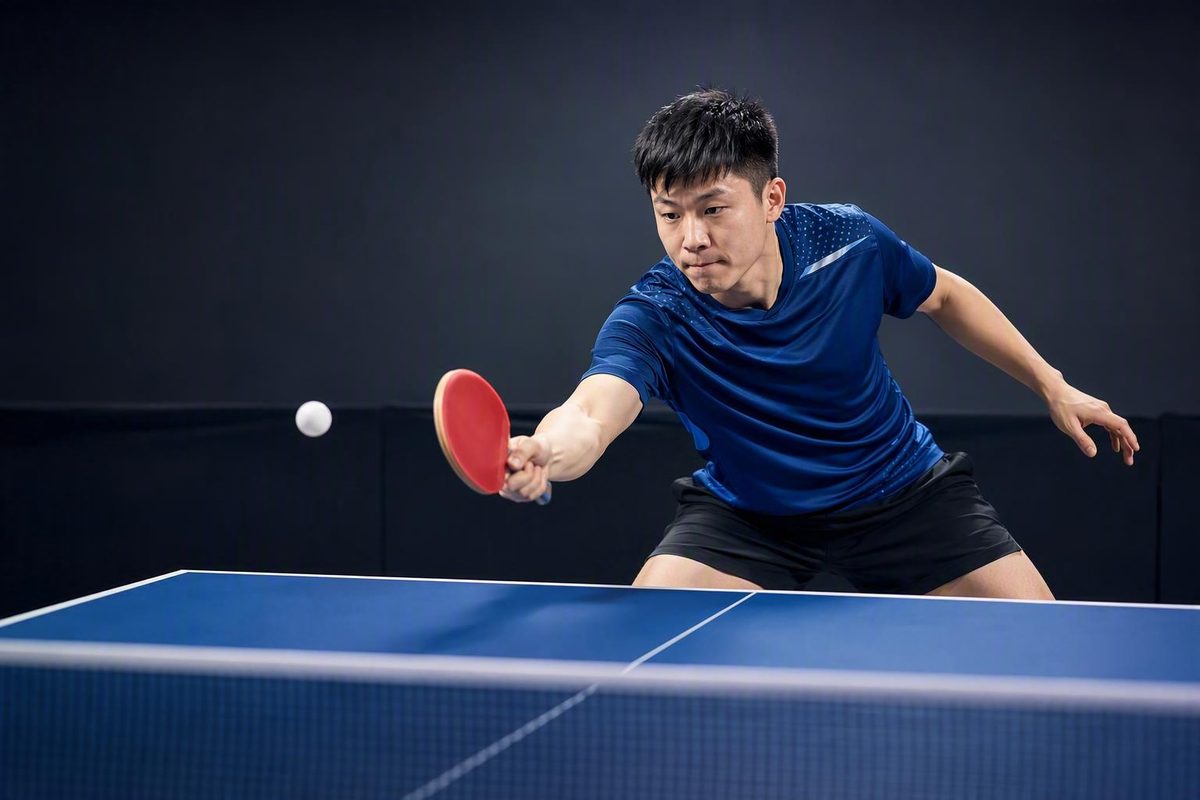
Create space, shorten the stroke, and choose the return you can control.
When a fast, low, deep backspin push crowds you, recover promptly from your previous shot and judge whether you still have room, balance, and preparation time. If you are late or crowded, adjust your feet or shorten the preparation rather than forcing a full swing.
This is a practical troubleshooting framework drawn partly from an amateur discussion of long backspin balls, not a validated prescription for every deep push. Contributors suggested earlier recovery, more space, and shorter preparation, but disagreed about controlled versus powerful looping.
Use This Quick Decision Table
Start with four observations: Is the ball deep and fast? Is there room between your body and the ball? Are you balanced? Did your preparation begin early enough?
| What you observe | Space and balance | Preparation | Practical choice |
|---|---|---|---|
| Deep and fast but manageable | Usable space; balanced | Early enough | Controlled opening loop |
| Particularly good opportunity | Plenty of room; balanced | Early and complete | Stronger loop is available |
| Ball is crowding you | An adjustment remains possible | Limited time | Create space or shorten preparation |
| Ball reaches the body too quickly | Late or off balance | Incomplete | Compact, active safety return |
A stronger loop is an option, not an obligation, when room, balance, and preparation all support it.
Here, a compact, active safety return means a return made with short preparation and positive intent, prioritizing a controlled ball on the table and readiness for the next shot rather than maximum speed or spin. The available evidence does not establish one exact stroke or set of mechanics for that emergency situation.
Otherwise, shorten the preparation. When neither response produces a stable contact, reduce ambition instead of forcing a full-power attempt.
Why This Ball Jams You
Keep the comparisons separate. A slower push may provide more time to read the ball and organize your feet. A half-long push creates a different depth and spacing problem, but it is not necessarily slow or easy.
Several habits can compound the pressure:
- Recovering late after the preceding stroke
- Using a preparation that requires more time or space than is available
- Remaining close when the incoming depth is already crowding the body
- Recognizing the ball’s depth only after it has entered the hitting zone
Treat the jam as a sequence problem. That makes recovery and positioning sensible first checks before you rebuild the swing or search for a new racket angle.
Fix Spacing Before You Fix the Swing
Stepping back is one possible correction when the ball is taking away your swing space. It is not an automatic response to every deep push. Often, the useful movement is a modest spacing adjustment—only enough to prevent contact from occurring beside or behind the body.
Shortening the preparation does not mean becoming passive. It means removing motion that cannot be completed before contact.
The adjustment should begin during recovery from the previous shot. Return toward a usable ready position and read the incoming depth as early as you can. Waiting until the ball has reached your body leaves you trying to move and strike at the same time.
Use this diagnostic:
If fast, deep pushes repeatedly reach you beside or behind the body, examine recovery, spacing, and preparation size before assuming racket angle is the only problem.
Video can help show whether you remain too close after your previous shot, begin with an unnecessarily large preparation, or react late to the ball’s depth. Do not rely on one fixed distance as the answer; test whether your position gives you enough room for the return you intend to play.
Choose Control or Power by Ball Quality
Choose the most ambitious return supported by the incoming ball and your position.
A controlled opening loop fits a situation in which you have usable separation from the ball and are balanced, but your preparation is not ideal for maximum acceleration.
Use the stronger loop selectively. It becomes reasonable when you read the depth early, create sufficient room, remain balanced, and complete your preparation without rushing. Trying to manufacture power from a crowded or unstable position may instead make clean contact more difficult.
When you are late, jammed, or off balance, use the compact safety return defined earlier. This might resemble a reduced attacking action or an active conservative return, but the evidence does not validate a universal stroke category, racket angle, or path for every fast, deep push.
Also distinguish this situation from receiving a short, heavy-backspin serve. Community advice for short balls sometimes recommends active contact and taking the ball early, near the bounce. A fast, deep push has different depth, incoming speed, and spacing demands, so those short-ball recommendations should not be transferred automatically.
The relevant player discussion itself did not settle whether controlled looping or power looping is generally better. Ball-by-ball selection is therefore more defensible than treating either option as mandatory.
Diagnose the Miss Without Chasing a Fixed Racket Angle
Racket angle and stroke direction need to respond to the incoming spin, speed, depth, and quality of your contact position. One numerical angle cannot account for every combination.
The angle-related suggestions below are diagnostic experiments borrowed cautiously from anecdotal discussion of short heavy-backspin returns. They are not validated corrections for fast, deep pushes.
| Miss or problem | Check first | Cautious experiment |
|---|---|---|
| Ball goes into the net | Was the contact active, and were you balanced? | Test slightly more opening or modestly more upward acceleration while retaining forward intent |
| Ball goes long or sits high | Was the racket excessively open or the action dominated by lift? | Reduce excess opening or lift, changing only one variable |
| Contact is consistently late | Did recovery and preparation begin soon enough? | Recover earlier and shorten preparation |
| Ball jams the body | Was there usable separation at contact? | Make a small spacing adjustment and use a compact return |
A netted ball does not prove that the racket was too closed. Late preparation, weak acceleration, poor spacing, or misreading the spin may produce a similar result. Likewise, a high or long return does not establish one technical fault; excess opening and excess lift are checks, not automatic diagnoses.
Change one variable at a time. If a more open racket sends the next attempt high or long, return to the full contact situation rather than continuing to increase the angle.
Train the Return From Predictable to Random
Build the response through a four-stage progression:
- Predictable deep pushes to one location: Begin with multiball or another controlled feed. Focus on recovery, spacing, and compact preparation.
- Deep pushes to either side: Read placement and adjust before choosing the return.
- Random or deceptive pushes: Vary placement and presentation so you cannot prepare the same response in advance.
- Opening return plus one continuation ball: After the opening, have the feeder block or send a topspin ball so you must recover immediately.
This structure follows Larry Hodges’s looping-against-backspin drill progression, which moves from controlled multiball toward either-side and random or deceptive pushes, then connects the opening loop with the subsequent rally. Serve-and-loop exercises can be added after the response becomes stable under controlled feeding.
At every stage, treat recovery as part of the repetition. Do not stop after making the opening shot; return to a usable position for the block or topspin continuation.
As a practical variation, add occasional feeds toward the body or playing elbow. This variation is an application of the spacing problem, not a drill specified by the coaching source. It forces a decision among a small foot adjustment, shorter preparation, and a lower-risk return.
Score repetitions with three observations rather than an invented success benchmark:
- Landed: Did the return reach the table?
- Controlled: Did you play the intended return without desperate contact?
- Recovered: Were you ready for the continuation ball?
Ping Pong King separately describes structured practice content involving multiball, robot drills, and match-oriented practice design. It also says its routines can be used solo, with a partner, or with a robot, although those pages do not establish a specific technique for returning fast, deep backspin pushes.
The practical priority is to solve time and spacing before adding power. Train the entire sequence—from recovery and return selection through preparation for the next ball—until it remains usable under random placement.