
Doubles rules in table tennis: who serves, receives and hits next
Learn doubles serve placement, the four-player hitting order, service rotation, deuce and deciding-game changes, then practise with a 10-minute drill.
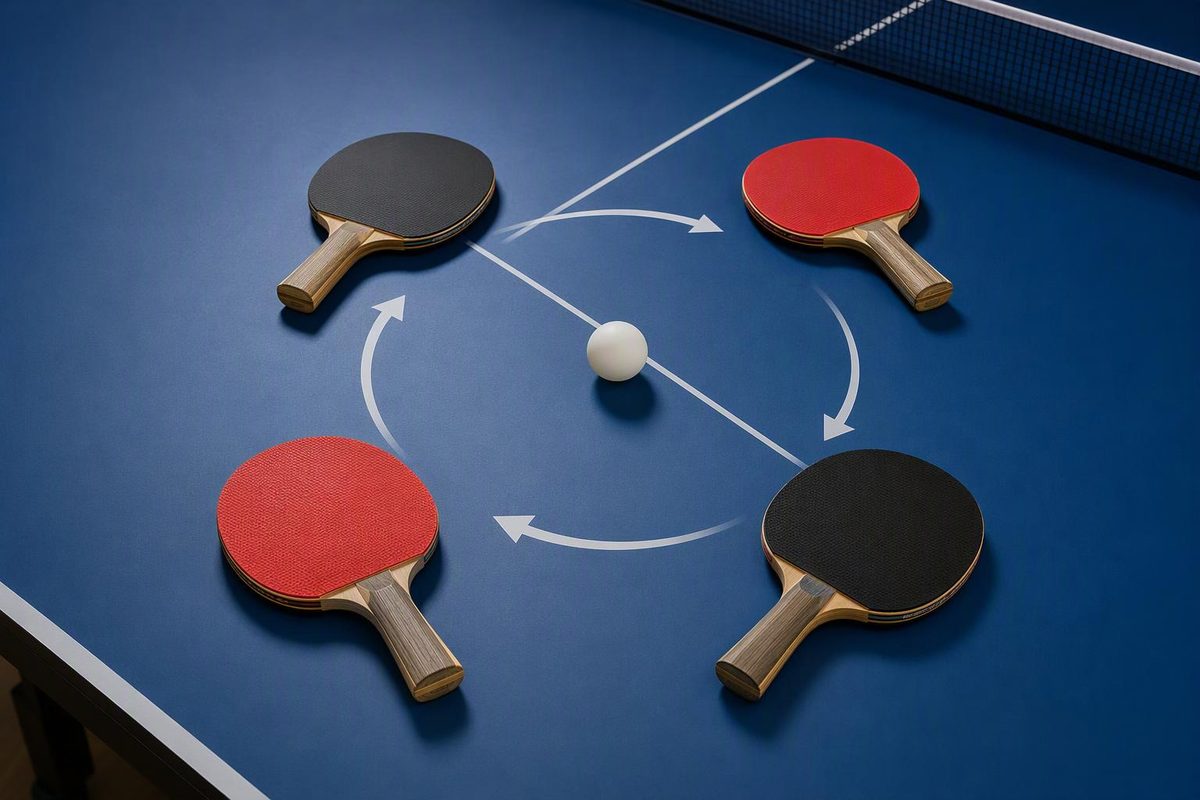
The main doubles rules are simple: serve diagonally from right half-court to right half-court, alternate shots with your partner, and follow a fixed serving and receiving order. After the serve, you can place the ball anywhere on the opponents’ court—not just diagonally.
Here is how to apply the ITTF’s 2026 Laws of Table Tennis, followed by a short four-player practice.
Serve right to right
Your serve must bounce first on your right half-court, then on the receiver’s right half-court, viewed from each player’s end. The white centre line counts as part of both right half-courts, so a bounce on it is legal.
The usual serve requirements still apply: start with the ball resting freely on the open palm of your stationary free hand, toss near vertically at least 16 cm without imparting spin, and strike the falling ball. Keep it above table height and behind your end line until contact. Neither you nor your partner may hide the ball from the receiver. Remove your free arm and hand from between the ball and net as soon as you toss. See ITTF Laws 2.1.6 and 2.6, or use our legal serve checklist.
A serve that clips the net and otherwise lands correctly is a let: replay it without adding a point or using up a service. Net contact alone does not save a serve that lands in the wrong half; that is a fault and loses the point. There is no second serve after a fault. ITTF Laws 2.9.1.1 and 2.10.1.1
Alternate every shot—not just every rally
Name one pair A and B, and the other C and D. If A serves to C, the hitting order is:
A serves → C returns → B returns → D returns → A returns, repeating until the rally ends.
You cannot take your partner’s shot because you are closer to the ball. Striking out of sequence after the serve and receive loses the point. Once the serve is returned, every return may land anywhere on the opponents’ court. ITTF Laws 2.7, 2.8.2 and 2.10.1.12
For standing-player doubles, there is no rule requiring each partner to stay in a separate half. Practically, hit and clear your partner’s path rather than guarding “your side.”
Wheelchair exception: if a pair includes a player in a wheelchair due to physical disability, either player of that pair may make subsequent returns after the initial serve and receive. For that pair, no part of the wheelchair or foot of a standing partner may cross the imaginary extension of the table’s centre line. ITTF Laws 2.8.3 and 2.10.1.15
Change service every two points
The initial choice of serving, receiving or ends is decided by lot; the other pair gets the remaining choice. In the first game, the serving pair chooses its first server, and the receiving pair chooses its first receiver. If those players are A and C, use this rotation:
| Service turn | Server | Receiver |
|---|---|---|
| First two points | A | C |
| Next two points | C | B |
| Next two points | B | D |
| Next two points | D | A |
| Then repeat | A | C |
Remember: the previous receiver becomes the server; the previous server’s partner becomes the receiver. Change after two points played, regardless of who wins them—not after two points won. ITTF Laws 2.13.1–2.13.5
Games are first to 11, with a two-point lead required. At 10–10, keep the same rotation but change service after every single point. One-point service turns also apply if the expedite system is introduced. ITTF Laws 2.11 and 2.13.3
Between games and at five in the decider
The pair that served first receives first in the next game. The new serving pair can choose either partner to start, but the first receiver must be the player who served to that chosen server in the previous game.
Switch ends between games. In the last possible game—game five of a best-of-five match, for example—switch ends when either pair first reaches five points. At that moment, the pair due to receive next also switches its receiving order. If A was due to serve to C, A now serves to D. ITTF Laws 2.13.4, 2.13.6 and 2.13.7
If someone serves or receives out of turn, or an ends change is missed, the umpire interrupts play when the error is discovered and corrects it at the current score. Previously scored points still count; do not rewind the game. This differs from taking your partner’s subsequent shot in a rally, which loses the point. ITTF Laws 2.10.1.12 and 2.14
A 10-minute doubles-order drill
Setup: four standing players, one table and several balls. No robot is needed. Assign A/B and C/D.
- Minutes 0–3: start A serving to C. Use controlled pushes or blocks and try to complete eight contacts in the correct order. After hitting, move clear without crossing your partner’s approach.
- Minutes 3–7: play points, changing service every two points. Before each serve, call the server and receiver by name.
- Minutes 7–10: start at 10–10 and practise one-point service turns. Then rehearse the deciding-game change at five: switch ends and identify the new receiver before resuming.
Checkpoint: complete a full four-server cycle without an order prompt, then manage the change at five correctly. Keep the strokes simple until the rotation and movement are reliable.