
Learn the Pendulum Serve: Contact, Spin and Short Placement
Build a pendulum serve with clear grip, swing and contact cues, then test short placement in a 20-minute solo table tennis session.
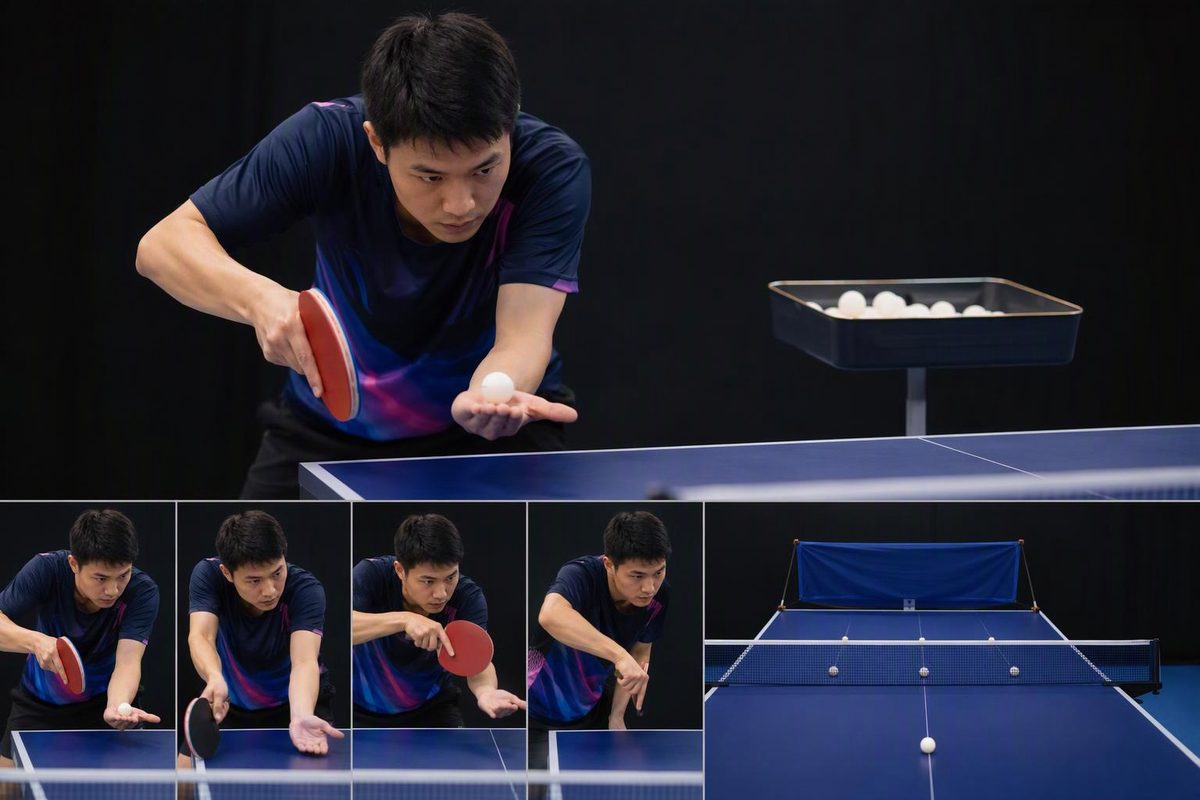
The pendulum serve is a forehand serve in which the forearm swings beneath a raised elbow, like a pendulum. Changing the racket angle and brushing direction lets you produce backspin, sidespin-backspin or sidespin from a similar action. Sidespin-backspin combines sideways rotation with backward rotation. Start with a short version; add variations once you can control its length.
Setup: a table, net, racket and basket of balls. This 20-minute session is solo—no partner or robot needed. A phone recording from the receiver’s position is useful for checking visibility. The instructions below assume a right-handed shakehand player; left-handers mirror them.
Build the action
1. Stand side-on and free the wrist
Start behind the end line near your backhand corner, with your left side nearer the table. Keep your knees comfortably bent and leave enough room to swing without striking the table.
For the serve, loosen the middle, ring and little fingers from the handle while retaining control with your thumb and index finger. Raise your elbow toward shoulder height and let the forearm hang beneath it. These are the starting cues used by PingSkills coach Alois Rosario.
Checkpoint: you can make several relaxed shadow swings without squeezing the handle or moving your whole arm as one stiff unit. Do not force the wrist into an uncomfortable position.
2. Make a legal toss—not a throw into the racket
Rest the ball freely on your stationary open palm. Toss it nearly vertically, without adding spin, at least 16 cm above the release point, then strike it as it falls.
From the start of service until contact, the ball must stay above the playing surface and behind your end line. Keep it visible to the receiver, and remove your free arm and hand from the space between the ball and net as soon as you toss. The serve must bounce first on your court, then on the receiver’s. These requirements come from ITTF service laws 2.6, reproduced by Table Tennis England in its July 2026 rules.
A side-on stance is not permission to hide contact behind your torso. Use the legal serve checklist if your toss or visibility needs work.
3. Brush underneath and sideways
Let the forearm swing under the elbow, with the racket travelling from your right toward your left through contact. Angle the forehand rubber upward enough to reach underneath the ball. For your first sidespin-backspin version, brush the lower part of the ball with a sideways component. Think “skim the rubber across the ball,” not “hit through it.”
Begin slowly enough to find contact. Once that is reliable, accelerate the racket through the brush rather than making a larger swing. Coach Larry Hodges’ pendulum-serve progression starts with grazing underneath for backspin, then develops sideways contact for sidespin-backspin and sidespin.
Keep contact low, but still above table height. For a short serve, aim initially for a first bounce nearer the net on your side, using a fine brush rather than a forceful forward hit. Hodges recommends both low contact and a near-net first bounce when developing short serves.
Checkpoint: when left untouched, the ball would bounce twice on the receiver’s side before leaving the table. That is your length test—not proof of heavy spin.
4. Recover immediately
After contact, restore your normal playing grip, turn toward the table and bring the racket into your ready position. Practise this after every serve, even without a receiver. The serve is not finished when the ball clears the net.
A 20-minute solo progression
Treat the following scores as practice targets, not universal standards. Include collection time within each block. For these tests, do not count net-touch serves as successes; replay them.
| Time | Action | Checkpoint |
|---|---|---|
| 0–4 minutes | Alternate relaxed shadow swings with legal toss-and-serve attempts. Ignore spin strength for now. | Toss stays near vertical; contact remains visible; no reaching after the ball. |
| 4–10 minutes | Serve sidespin-backspin in sets of 10 toward one receiving area, such as the middle third of the table. Let each ball continue bouncing. | Record serves that pass your legal checklist and short serves separately. Aim for 7 of 10 that satisfy both. |
| 10–16 minutes | Alternate sets of five to two receiving areas. Keep the same spin intention and short length. | Change placement without turning the serve into a hard hit. Note which target loses length control. |
| 16–20 minutes | Complete a 10-serve test, choosing the target before each toss. Restore your grip and ready position after every attempt. | Count only serves that pass your legal checklist, stay short and land in the intended area. Save the score for your next session. |
If you cannot reach the length target, keep one placement for the whole session. Do not add a second problem before the first is stable.
Fix the miss you can see
- The ball goes long: reduce the forward hit and seek a finer brush. Check where the first bounce lands rather than simply slowing the entire motion.
- The ball sits high: lower the contact while keeping it above the playing surface. Check that you are not scooping upward through the ball.
- You miss contact: simplify the wrist action and stabilise the toss before chasing more spin.
- You finish trapped side-on: rehearse serve–restore grip–ready position as one sequence.
Once the short version is dependable, try more sideways contact for a sidespin variation while retaining the same preparation. If a partner is available, spend five extra minutes serving both versions and asking them to use a consistent return. Compare the resulting returns, then play the third ball—your first shot after their return. Solo practice lets you work on legal mechanics and placement; a receiver helps you test the spin and check visibility from across the table.