
How to Serve Legally in Table Tennis
Check the open-palm, near-vertical 16 cm toss, visibility, descending contact and two-bounce sequence, plus singles, doubles, lets and faults.
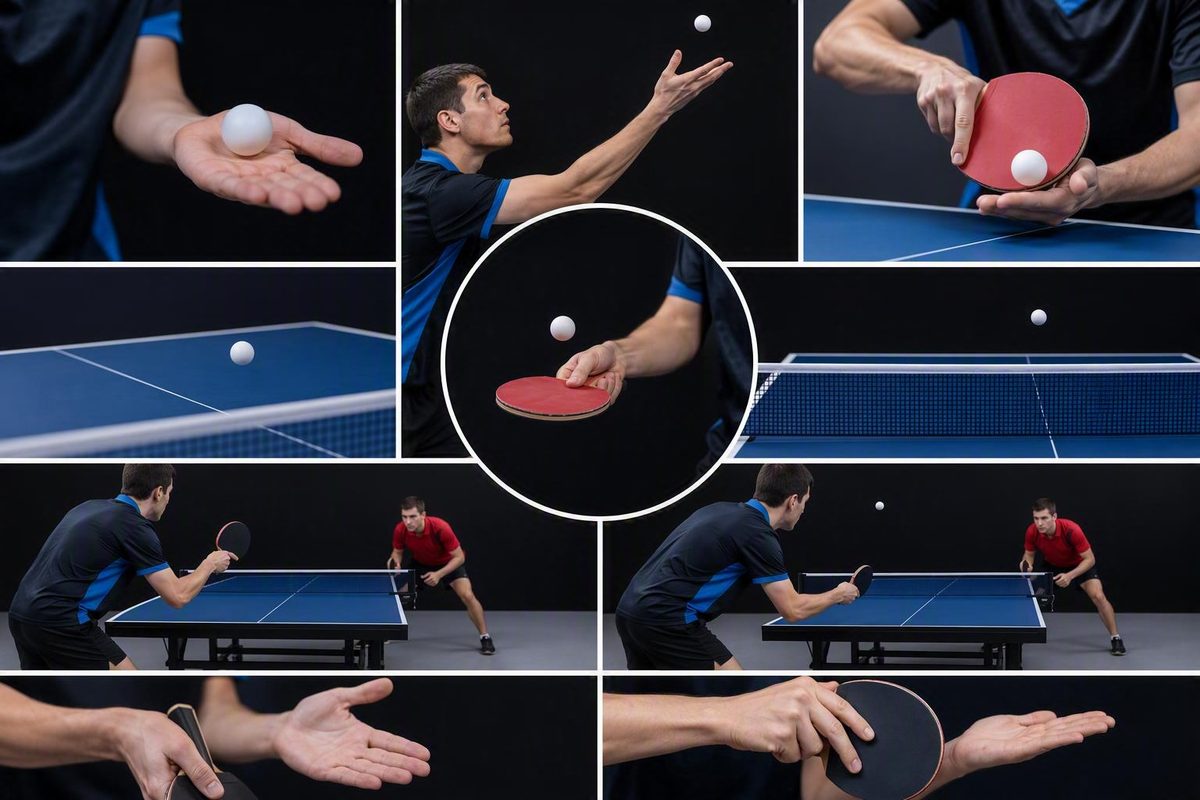
A legal table tennis serve begins with the ball resting on an open palm. Project it upward without using the hand to impart spin, make it rise at least 16 cm (approximately 6.3 inches), and strike it while it is descending. Until contact, keep the ball visible, above the playing surface, and behind the end line. It must then bounce first on your court and directly on the receiver’s court. Singles placement is open; doubles serves go from right half-court to right half-court. These requirements are reflected in published guidance summarizing the core service rules.
For a sanctioned competition, check the rulebook and regulations adopted by the event organizer. This practical guide draws on USA Table Tennis guidance, including material linked as January 2024 rules, and third-party reproductions or summaries of ITTF service wording. It should not be treated as a substitute for the rules governing a particular event.
The legal-serve checklist
Use this checklist before every competition serve:
- Present the ball on an open palm. Rest it freely on the open, stationary palm of your free hand. Do not grip, pinch, or hold it between curled fingers.
- Release it near vertically. Project the ball upward without imparting spin through the throwing hand.
- Clear the minimum height. The ball must rise at least 16 cm, approximately 6.3 inches, after leaving your palm. “Six inches” is common shorthand but is not an exact conversion.
- Wait for the descent. Strike the ball while it is falling, not while it is still rising.
- Keep the ball in the legal starting area. From the start of service until racket contact, the ball must remain above the playing surface and behind your end line.
- Keep the ball visible. The receiver must be able to see it throughout the pre-contact sequence.
- Move your free arm away. As soon as you release the ball, remove your free arm and hand from the space between the ball and the net.
- Make both required bounces. The ball must touch your court first and then directly touch the receiver’s court.
This sequence follows the service-law wording reproduced from an ITTF Handbook, including the stationary open palm, near-vertical 16 cm toss, descending contact, visibility, free-arm removal, and two-bounce sequence.
A serve can look smooth, spin heavily, and land awkwardly for the receiver yet still be illegal because of its toss or visibility. Judge the whole action, not only where the ball finishes.
From palm to second bounce: the serve timeline
Breaking the serve into stages makes it easier to find the exact point at which an illegal action occurs.
1. Stationary palm: Begin with the ball resting freely on the open palm of your stationary free hand. Starting from fingers wrapped around the ball does not satisfy this requirement.
2. Release: Project the ball near vertically upward. The throwing hand must not add spin. The release should be clear enough for the receiver and an official to follow.
3. Rise: The ball must rise at least 16 cm after leaving the palm. Measure from the release point to the top of the ball’s rise rather than from the table.
4. Descent: Allow the ball to reach its peak and begin falling. Contact while the ball is still rising does not satisfy the described service sequence.
5. Racket contact: Strike the descending ball. Until this moment, the ball must be above the playing surface and behind the server’s end line. The rule is about the ball’s position; it does not say that the server’s entire body must remain behind the line.
6. Server-side bounce: After contact, the ball must first touch the server’s court. Hitting directly onto the receiver’s side is not a legal serve.
7. Receiver-side bounce: The ball must then pass over or around the net assembly and directly touch the receiver’s court. In doubles, both bounces are subject to the right-half-court restriction explained below.
Visibility applies throughout the sequence before contact. The server, a doubles partner, clothing, or anything either player wears or carries must not hide the ball from the receiver. A shoulder, torso, sleeve, or free arm matters when it actually obstructs the receiver’s view; its position alone does not automatically establish concealment.
The free arm and hand also have a specific job after release: they must move out of the space between the ball and the net. A player should not leave the arm in front of the ball and expect the receiver or official to reconstruct what happened.
The prohibition on spin applies to the hand projection, not to racket contact. You may create backspin, sidespin, topspin, or combined spin by brushing the ball with the racket after a compliant toss.
“Near vertically” is not accompanied by a numerical angle or tolerance in the supplied service-law wording. Do not build your action around an invented allowance such as a particular number of degrees. A clearly upward toss is easier to repeat and easier for a receiver or official to assess than one that travels conspicuously sideways or back toward your body.
Your stance, forehand or backhand action, racket path, spin type, target, and tactical disguise are technique choices rather than separate service requirements. They remain optional only while the mandatory toss, visibility, contact, and bounce rules are met.
Singles versus doubles serving rules
No, a table tennis serve does not always have to travel diagonally. The diagonal placement restriction applies to doubles.
| Requirement | Singles | Doubles |
|---|---|---|
| First bounce | Anywhere on the server’s court | Server’s right half-court |
| Second bounce | Anywhere on the receiver’s court | Receiver’s right half-court |
| Diagonal placement required? | No | Yes, right half to right half |
| Center-line bounce | No special placement issue | Counts as part of the right half-court |
In singles, you may serve down the line, crosscourt, toward the middle, short, or long. The placement test is that the ball first touches your court and then directly touches the receiver’s court.
In doubles, both bounces are restricted: the first must be on the server’s right half-court and the second on the receiver’s right half-court. A ball touching the center line counts as landing on the right half-court for this purpose, according to PongFit’s rules summary.
Doubles also uses a defined serving and receiving order. Because simplified summaries do not provide equally reliable treatment of the complete four-player rotation, check the rules adopted by your competition rather than inferring the sequence from the diagonal-service requirement.
Legal serve, let, or fault?
A net touch does not automatically make a serve a let. First determine whether the serve was otherwise legal and whether it landed in the required area.
| Scenario | Ruling | Result |
|---|---|---|
| Toss and visibility requirements are met, and the ball bounces in the required areas without touching the net | Legal serve | Play continues |
| An otherwise legal serve touches the net and then lands in the required receiver-side area | Let | Replay the serve; no point is awarded |
| The serve touches the net but fails to land in the required receiver-side area | Fault | Receiver wins the point |
| Toss rises less than 16 cm | Incorrect service | Does not qualify as a legal serve |
| Toss is not near vertical or the hand imparts spin | Incorrect service | Does not qualify as a legal serve |
| Ball is struck while rising | Incorrect service | Does not qualify as a legal serve |
| Ball is concealed or the free arm is not removed as required | Incorrect service | Does not qualify as a legal serve |
| Ball misses the server’s court or does not directly reach the required receiver-side court | Fault | Incorrect bounce sequence |
The table describes clear violations, not an action whose legality an official merely considers doubtful. Competition enforcement should be determined under the rulebook and officiating procedures adopted for that event.
Published service guidance reports that an otherwise legal net serve is replayed and that repeated legal net lets do not carry a stated limit or point deduction. A net-touching serve that lands incorrectly remains a fault rather than becoming a let. These distinctions are summarized in the cited table tennis serving guidance.
When service changes
Service normally changes after every two points, regardless of who won them. A game is played to 11 points, but the winner must lead by two. If the score reaches 10-10, service changes after every point until one player establishes a two-point lead. USA Table Tennis summarizes this scoring and service sequence.
A simple sequence looks like this:
- Player A serves for two points.
- Player B serves for two points.
- Player A serves the next two, and the pattern continues.
- If the score reaches 10-10, A serves once.
- B then serves once.
- They continue alternating one serve each until someone leads by two, such as 12-10 or 15-13.
The service rotation does not determine who can score. Either player may win any point, regardless of who served, and there is no requirement to win the final point on your own serve.
Match formats vary by competition. Whether a match uses a best-of-three, best-of-five, or another format does not alter this game-level sequence unless the event has adopted different regulations.
A five-point self-audit for fixing an illegal serve
Use a phone camera, a box of balls, and a temporary height marker to audit your action before adding more spin or disguise.
-
Palm: Pause at the start. Is the ball resting freely on an open, stationary palm, or are your fingers gripping or supporting it from the sides? Make the starting position unmistakable.
-
Toss height: Place a temporary marker 16 cm above the release point during practice. Check whether the ball rises at least that far rather than relying on feel. Keep the marker away from the playing area so it does not interfere with the action.
-
Toss direction: Watch the flight from the front and side. Does the ball rise near vertically, or does it travel noticeably sideways or back toward your body? Assess the visible path rather than trying to calculate an unofficial angle.
-
Visibility: Film from approximately the receiver’s viewpoint. Check whether your free arm, shoulder, torso, clothing, or doubles partner hides the ball at any stage. Confirm that the free arm and hand move away immediately after release.
-
Contact and bounces: Verify that racket contact occurs after the ball begins descending. Then confirm a bounce on your court followed directly by a bounce on the correct part of the receiver’s court. A ball reaching the opponent is not enough if the toss, contact, or first bounce was illegal.
Correct one issue at a time. Start with a repeatable palm position and toss. Then fix visibility, descending contact, and the complete bounce sequence. Only after that foundation is stable should you add tactical variation.
Ping Pong King’s spin-serve training covers heavy backspin, forehand sidespin, disguised no-spin options, and a structured practice plan. Treat those as techniques layered onto a legal service action, never as alternatives to the service requirements.
The playable rule of thumb is simple: make the entire serve easy for the receiver and an official to see—open palm, visible near-vertical 16 cm toss, descending contact, and the correct two bounces. Once that sequence is repeatably legal, work on spin, placement, and disguise.
Is a serve legal if it hits the top edge or bounces more than once on the receiver’s side?
In singles, it can be. The serve must first satisfy the other service requirements and make the required initial bounce on each court. A contact with the top edge can count, and the ball may bounce more than once on the receiver’s side after its first legal receiver-side bounce. The vertical side of the table is not part of the playing surface. These edge and multiple-bounce situations are covered in the PongFit summary.
In doubles, the initial bounce on each side must still occur on the respective right half-court.
Can service requirements be relaxed for a player with a physical disability?
Yes. The reproduced service-law wording says an umpire may exceptionally relax correct-service requirements when satisfied that a physical disability prevents compliance. This is an officiating accommodation based on the player’s circumstances, not a general exception that players apply themselves. The provision appears in the cited reproduction of the service laws.