
Build a Doubles Pair That Clears Space and Attacks Together
Train table tennis doubles with a 30-minute session for four players: legal serves, partner movement, third-ball choices and measurable spacing checks.
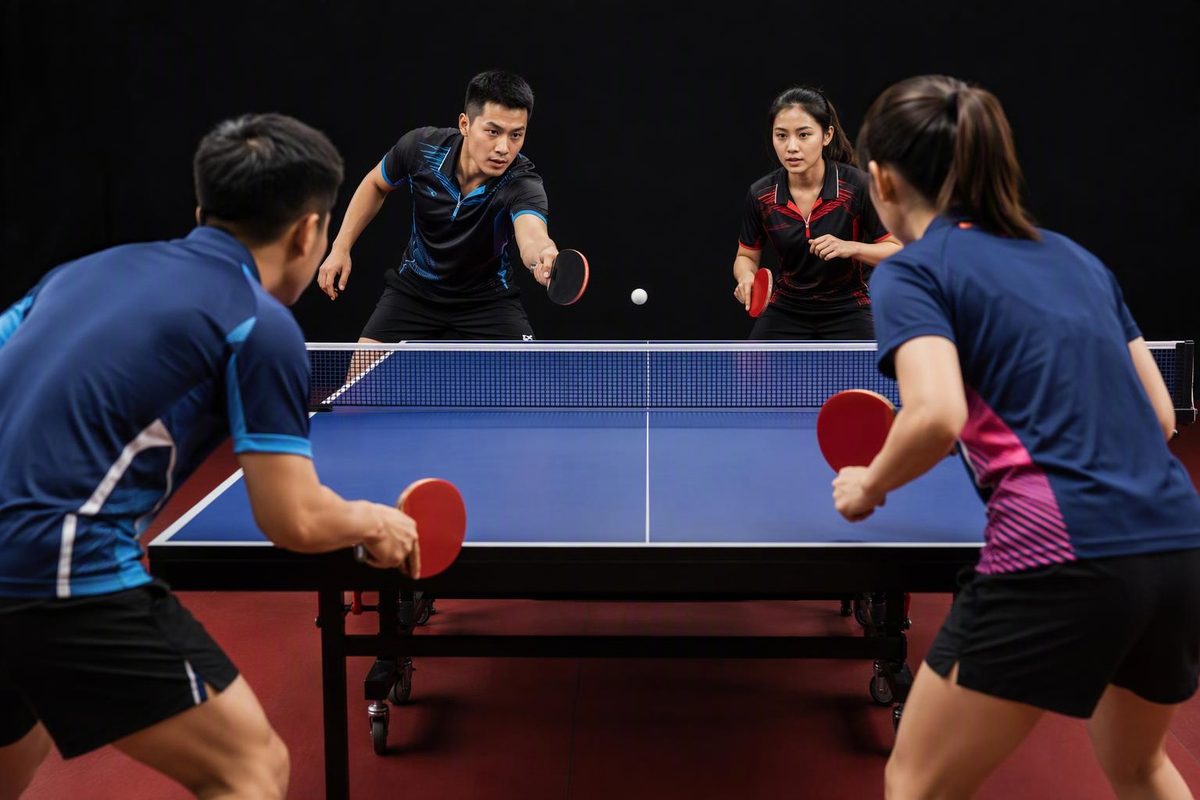
To improve your table tennis doubles, train the handover: hit, clear your partner’s path, then prepare for your next turn. This 30-minute session for four standing players builds that movement into cooperative rallies, serves planned for your partner’s third ball, and scored play.
Choose a practice block to see who serves, who receives and who plays the third ball.
Serve and Third-Ball Order
Pairs: A + B and X + Y. Use these blocks during minutes 13–23.
B Plays the Third Ball
A → X → B → Y → A
A serves, then clears B’s approach and swing path. Repeat the order until the rally ends.
| Server | Receiver | Third Ball |
|---|---|---|
| A | X | B |
| X | B | Y |
| B | Y | A |
| Y | A | X |
Source: the practice session below. These are training blocks, not match service intervals; standing doubles only.
Setup: four players, one table, spare balls and a timer. Begin after your usual warm-up, and keep spare balls out of the movement area. A robot or solo session can develop individual strokes, but this practice needs live partners to train shared space and playing order.
Keep the Doubles Playing Order Clear
Label one pair A and B, and the other X and Y. If A serves to X, the rally follows:
A → X → B → Y → A, repeating until the point ends.
The serve must bounce first in the server’s right half-court, then in the receiver’s right half-court; the centre line counts as part of the right half. After the serve, returns can land anywhere on the opponent’s court. These are the standard doubles requirements in the 2026 ITTF laws reproduced by Table Tennis England, sections 2.1.6, 2.6.3, 2.7.1 and 2.8.2. Wheelchair doubles has a specific playing-order exception; this session is for standing pairs.
For service rotation, deuce and deciding-game changes, use the separate doubles rules guide. The practice blocks below are not match service intervals.
Clear Space Before Your Partner’s Shot
Do not finish your stroke and stay planted in your partner’s hitting space. Move out of their approach and swing path, keep watching the ball, then prepare for your next turn.
There is no single movement route for every pair or placement. PingSkills coach Alois Rosario recommends starting slowly and adjusting the movement around the partner: sometimes clearing to the side is enough; sometimes moving around is appropriate. The aim is to remain near a useful central position without crowding your partner. See his doubles footwork guidance.
Observable cue: your partner can step into the ball without stopping, reaching around you or shortening their stroke to avoid contact. Agree an initial clearing route, but do not force it when the ball or your partner’s position changes.
Serve for Your Partner’s Third Ball
The third ball—the shot after the serve and receive—belongs to your partner, not you. Before serving, agree the spin and length, then choose a serve whose likely return your partner is comfortable handling.
A useful starting option is short backspin near the centre line, within the legal right half-court. “Short” means the ball would bounce twice on the receiver’s side if left untouched. Leave a placement margin rather than trying to skim the line.
Coach Tom Lodziak recommends short-to-middle serves as a containing option and stresses matching spin choices to your partner’s strengths. He also notes that wide serves can give a mobile receiver wider return angles: wide placement is not automatically better. See his doubles serving advice.
Start with a serve you can control. Add a disguised no-spin variation only when both players understand the plan; the three spin serves guide covers those mechanics.
Minutes 0–5: Shadow the Handover
Work as two pairs at opposite ends, without a ball.
- A shadows a compact stroke, then clears space.
- B steps into a ready position and shadows the next stroke.
- Alternate, keeping each other’s approach and swing paths clear.
- Repeat from central, wider and close-to-table positions.
Keep the pace slow enough to change a poor route immediately.
Checkpoint: can you complete ten alternating strokes without contact or either player having to dodge? If not, reduce the swing and movement speed before adding a ball.
Minutes 5–13: Rally Cooperatively in Doubles Order
A serves legally to X. Continue in the A–X–B–Y order, aiming controlled returns towards the middle of the opposite court. Use pushes against backspin or gentle drives and blocks against topspin; this is movement practice, not a power test.
After each rally, identify the first breakdown: stroke, order or spacing. Change one thing before restarting. Give each player a turn starting the rally, confirming the receiver and hitting sequence first.
Checkpoint: record your longest rally and any spacing breakdowns. Aim first for eight consecutive contacts in the correct order with nobody blocking their partner’s path. If necessary, lower the pace rather than relaxing the alternating order.
Minutes 13–23: Connect the Serve to the Third Ball
Use four blocks of 2½ minutes so everyone practises serving and playing their partner’s third ball:
| Server → Receiver | Third-Ball Player |
|---|---|
| A → X | B |
| X → B | Y |
| B → Y | A |
| Y → A | X |
At the start of each block, leave two serves untouched to check whether they would bounce twice on the receiver’s side. Then use live receives.
For each start:
- Server tells their partner the intended spin and length.
- Server delivers a short backspin serve towards the centre-line area, then clears space.
- Receiver chooses a realistic return rather than feeding a guaranteed easy ball.
- Server’s partner chooses the third-ball response, then the rally continues freely in doubles order.
Do not require an attack on every third ball. Push a difficult short backspin return; open with topspin against a suitable long backspin return; control-block an attacking receive if that is the available shot.
Checkpoint: tally two separate things: serves that achieved the intended placement and length, and third-ball opportunities played with clear space. Keeping those counts separate helps distinguish serve-control problems from problems with the pair’s movement. An intercepted serve’s length is an estimate; use the untouched serves to calibrate it.
Minutes 23–30: Test the Handover in Scored Play
Play under normal doubles rules. Before each serve, briefly confirm the plan with your partner. Keep the scoreboard separate from one training tally: rallies where the outgoing player blocked the incoming player’s approach or swing. Record the total number of rallies too, so you can compare sessions with different amounts of play.
Between games, choose just one adjustment—more controlled serve length, earlier clearing or less ambitious third-ball placement. In your next session, compare the proportion of rallies with spacing problems to check whether the handover works at match pace, not just during cooperative rallies.