
Improve Your Table Tennis Footwork: Move, Hit, Recover
Build better table tennis footwork with a 30-minute session: shuffle steps, two-point feeds, random placement and a match check. Solo options included.
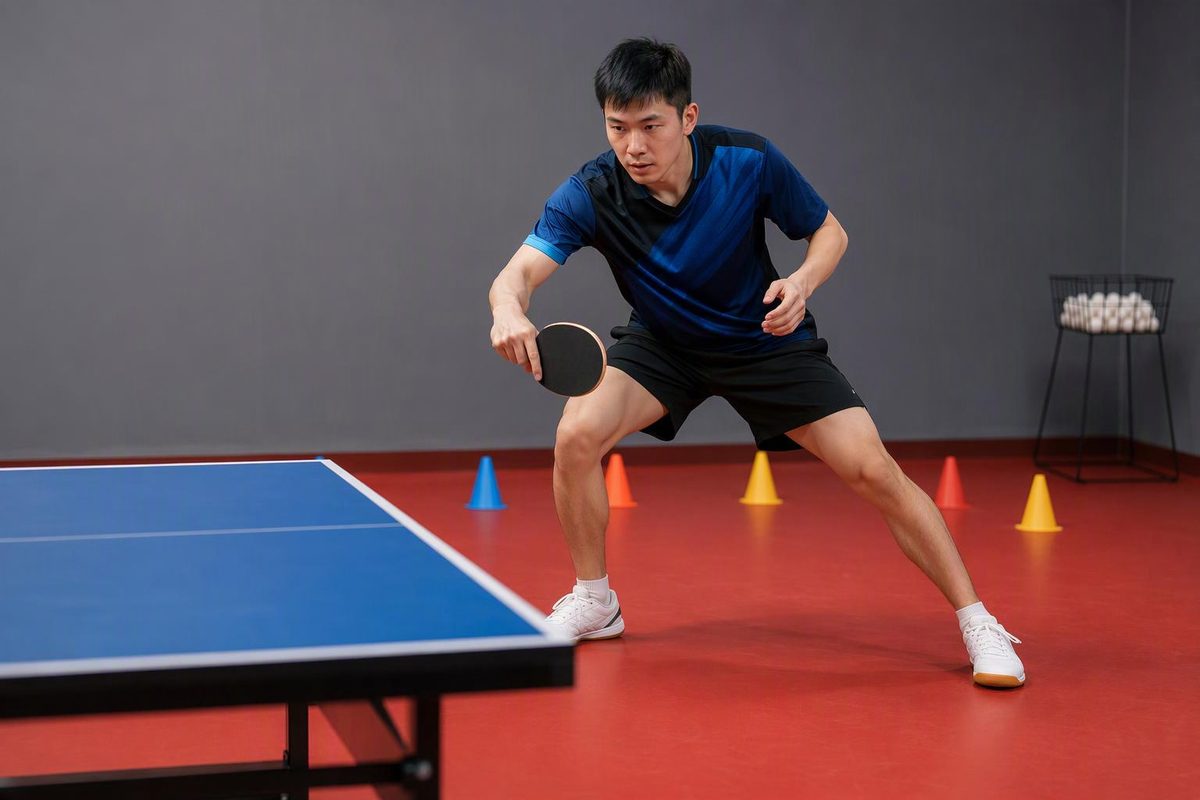
To improve footwork, practise getting into position and recovering for the next ball, not just moving faster. Start with a predictable two-point pattern, then remove the certainty about where the ball will land.
This 30-minute session focuses on lateral movement close to the table. Use a partner who can block or feed consistently, or a robot with adjustable placement. A solo alternative follows below. Allow extra time for warming up.
Set your stance and learn the two-step movement
Start with feet roughly shoulder-width apart, knees comfortably bent, weight toward the balls of your feet and racket in front. Stay relaxed rather than crouching as low as possible. Table Tennis England’s league-player notes recommend this ready-position framework and positioning yourself to cover the table according to the opponent’s location.
For this session, use a small closing step followed by an opening step:
- To move right, bring the left foot a little toward the right, then move the right foot outward.
- To move left, reverse the sequence.
- Keep the steps compact: do not bring your feet together or cross them for these short lateral movements.
Begin slowly, then let the movement become a smooth shuffle. The same federation notes describe left-foot-first movement to the right. Your checkpoint is simple: after moving, you should still have a usable stance—not be leaning sideways with your feet bunched together.
Move your body enough to preserve your normal stroke spacing. For a forehand, contact should remain in front and to the side of your body; do not chase every ball directly behind its flight line.
Recovery does not mean returning to the exact centre after every shot. Rebalance and adjust to cover the likely next return, watching the opponent rather than a spot on the floor.
The 30-minute footwork session
Warm up first using the off-table warm-up routine. Clear loose balls from the floor and begin with a movement width you can cover comfortably.
The times below include rests and role changes.
1. Shadow movement — 4 minutes
Both players can do this together, with enough space between them.
Complete four rounds of 30 seconds moving, 30 seconds resting:
- Start in your ready stance.
- Shuffle to one imagined ball location.
- Make a compact shadow forehand.
- Recover your balance, move to the other location and repeat.
Keep your head at a reasonably steady height. Avoid standing upright between strokes or throwing your upper body sideways to reach.
Checkpoint: finish each stroke able to move either way without an extra balancing step. Slow down if you cannot.
2. Predictable two-point forehands — 10 minutes
Ask your partner to alternate gentle feeds or blocks between two locations on your forehand half: one nearer the middle, one wider. Play controlled forehand drives or topspins back to a broad target in front of the feeder. This keeps their placement task manageable.
Use 40 seconds of work, then 20 seconds to rest and switch roles, for ten rounds. Each player gets five working rounds. With a robot, use the same intervals for work and rest; shorten the working intervals if your movement quality drops.
The pattern is move, hit, recover, not hit while stretching and then scramble. Keep the feed slow enough to complete it. PingSkills recommends two-point forehand work and combining strokes with movement rather than practising only from a static position. Here, the narrower placement keeps the focus on compact shuffles.
Checkpoint: assess ten feeds that land in the intended locations. Aim for eight returns that land with normal stroke spacing and a balanced recovery. Treat that as a practice target, not a universal standard. If you fall short, narrow the placement or slow the feed before increasing effort.
3. Unannounced placement — 8 minutes
Keep the same two locations, but let the feeder choose either one without announcing it. Use eight rounds of 40 seconds working, 20 seconds resting or switching.
Do not start moving merely because the previous ball went to one side. Watch the feeder’s contact and the ball’s direction. PingSkills recommends random-placement drills to practise reacting and recovering to a balanced stance.
Checkpoint: tally reaching contacts and balls that crowd your body. If these increase sharply, make the feed easier. You are testing positioning, not survival at maximum speed.
4. Match check — 8 minutes
Play normal points. Use whichever stroke suits the ball; do not force the two-forehand drill into every rally.
For each player, tally up to ten receiving points within this block. Between points, have your partner note whether you recovered from the receive into a balanced, usable position before their next contact. Record successful recoveries separately from points won, along with the number of receiving points observed.
Watch for an in-and-out problem too: after stepping in for a short return, do you remain leaning over the table? ActiveSG’s footwork guide describes moving in to play a short ball, then moving back out to the ready position. For right-handers, the right foot commonly steps under the table; left-handers mirror this.
Training without a partner
Robot: use alternating placement for block two and random placement, if available, for block three. If it cannot randomise placement, repeat the predictable drill rather than treating it as reaction practice. Replace the match check with short sequences beginning from a ready stance. This tests movement and recovery, but not reading an opponent’s stroke.
Solo: use shadow strokes at two locations, then add a step-in short-return action followed by recovery. Film a short set from the front to check stance width and sideways leaning. Keep the sets brief; shadow practice cannot test your response to an unpredictable ball.
At your next session, repeat the same feed width and pace before making the drill harder. Compare balanced contacts and recovery—not just your longest rally.