
7 Table Tennis Drills for a Focused 60-Minute Practice
Run a focused 60-minute table tennis session for consistency, footwork, placement, serves and third-ball attacks, with partner and robot options.
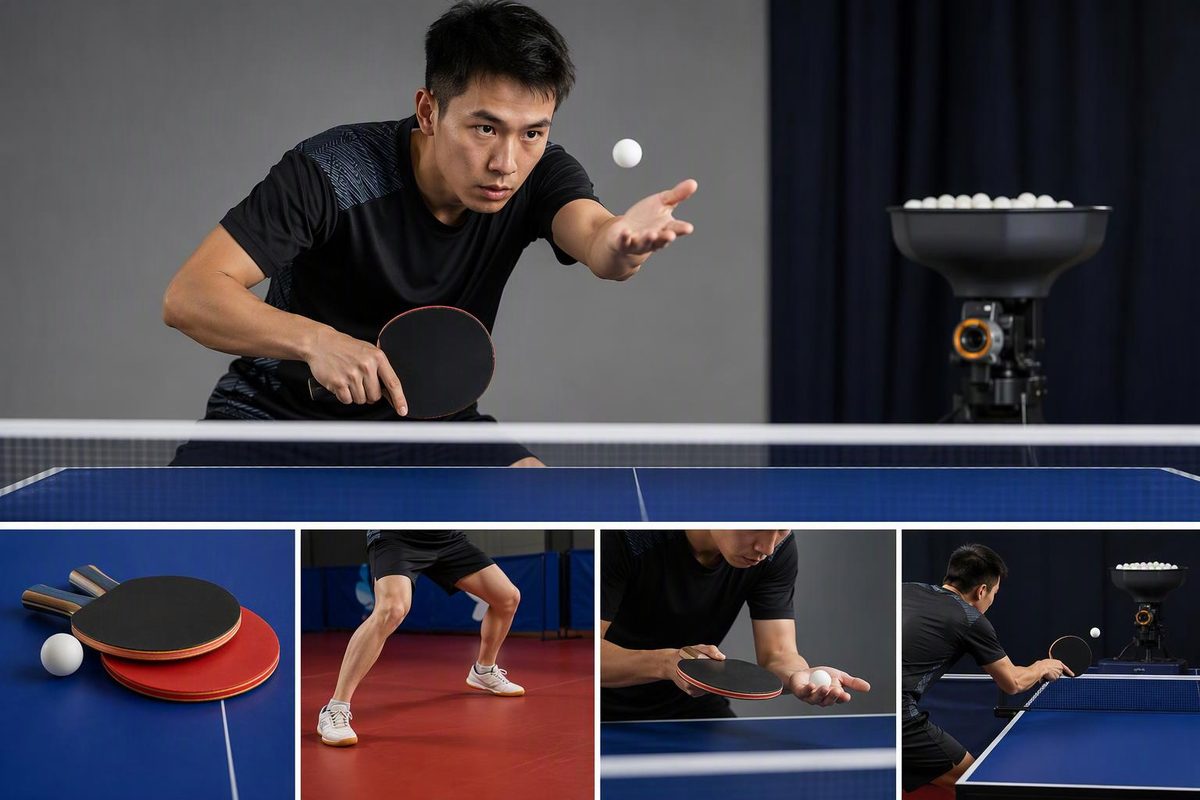
This session moves from predictable control to match-like decisions. The seven blocks total 60 minutes at the table, including brief role changes and ball collection. It is designed for two players, but most drills include a robot option. The serve block can be done solo.
Equipment: table, balls, two small flat paper targets and, optionally, a robot. Complete a brief off-table warm-up before the 60-minute session.
Record one useful number in every drill: a best rally, complete patterns or target hits. Stop counting a repetition when your stroke, movement or balance breaks down.
1. Crosscourt consistency: 6 minutes
Setup: Partner or robot. Play backhand to backhand diagonally for three minutes, then forehand to forehand for three. Use cooperative blocks or counterhits rather than trying to win the rally.
Action: Start with a target of 12 consecutive shots. After reaching it twice with sound technique, aim for 20. Keep the pace low enough to repeat the same compact stroke.
Checkpoint: Contact should remain in front of your body. If you start reaching, leaning or contacting beside your hip, reduce the speed and restore your spacing.
This simple opening follows ITTF High Performance Elite Coach Massimo Costantini’s progression: fixed diagonal or down-the-line placements before random variation, with 12–16 quality contacts as an initial rally target (ITTF Education).
2. Backhand–forehand transition: 7 minutes
Setup: Partner blocks alternately to your backhand and forehand while you return every ball to one fixed corner. A robot can oscillate between two fixed positions.
Action: Play one backhand and one forehand repeatedly. Alternate the hitter every 90 seconds, completing two turns each; use the remaining minute for changeovers and recording each player’s best run.
Move with short side steps rather than planting both feet and reaching. Finish each stroke, bring the racket back toward neutral and arrive before the next bounce.
Checkpoint: Listen to the rhythm. Contacts should sound evenly spaced. A late forehand or rushed backhand usually means your recovery stopped after the previous shot.
3. Two backhands, one forehand: 7 minutes
Setup: The hitter returns every ball to the partner’s backhand. The partner blocks twice to the backhand corner and once to the forehand corner. A robot can run the same three-ball pattern if programmable.
Action: Play two backhands and one forehand, then repeat. Count complete three-shot cycles rather than individual contacts. One player hits for three minutes, then switch; use the remaining minute for the changeover and score check. Aim first for five clean cycles, then eight.
Backhand–forehand combinations, including two backhands and one forehand, are one of the transition progressions identified in Costantini’s guidance (ITTF Education).
Checkpoint: After the forehand, recover immediately toward a neutral position. Do not watch the shot while remaining stranded on the forehand side.
4. Falkenberg footwork pattern: 10 minutes
Setup: The hitter directs every shot to the partner’s backhand. The partner blocks to this repeating sequence:
- backhand corner: hitter uses a backhand;
- backhand corner again: hitter steps around and uses a forehand—called a pivot;
- forehand corner: hitter uses a forehand;
- repeat.
A three-point programmable robot also works. Start at moderate speed with little placement spread.
Action: Work in 60-second rounds, allowing about 30 seconds to collect balls or change roles. Complete three rounds each within the 10-minute block. Count full three-shot patterns completed without losing balance.
This backhand, pivot forehand and wide-forehand sequence is commonly called the Falkenberg drill (TableTennisCoaching.com).
Checkpoint: Judge the drill by recovery, not power. After the wide forehand, your first movement should take you back toward the backhand corner. If you cross your feet during the short pivot or fall sideways after the wide ball, slow the feed.
5. Middle-or-corner decision drill: 8 minutes
Setup: Partner blocks unpredictably to either your forehand corner or your middle—the area around your playing elbow, where you must choose a forehand or backhand. With a robot, use random oscillation over half to two-thirds of the table.
Action: Topspin every ball to one fixed destination, such as the blocker’s backhand. Play for two minutes, switch roles and repeat so each player gets two turns.
Call “forehand” or “backhand” before contacting every middle ball. The call makes late or hesitant decisions obvious.
Checkpoint: Move away from the middle ball to create room for the chosen stroke. If the racket becomes trapped against your torso, you identified the ball but did not adjust your feet.
Add this uncertainty only when the fixed patterns are stable. The ITTF progression places middle-and-corners random work after simple transitions, once the arm, trunk and legs are working together consistently (ITTF Education).
6. Serve placement ladder: 10 minutes
Setup: Solo. Put one flat paper target short on the forehand side and another in the final third of the backhand side. Use a box or bowl of balls, but hold only one ball at a time so every serve has a deliberate setup.
Action: Choose one serve and complete this ladder:
- five legal serves short to the forehand;
- five legal serves short to the backhand;
- five fast, deep serves to the backhand;
- five serves to any called target, naming it before each toss.
Award one point when the serve reaches the intended zone and depth. Record the score out of 20. A short serve should be capable of bouncing at least twice on the receiver’s side if untouched. For a deep serve, the first bounce on the receiver’s side should land in the final third; the next bounce should be near or beyond the end line.
Check legality as well as placement with this serve-rules checklist. If you need a spin to train, choose one from your first three spin serves.
Checkpoint: Keep your starting routine and toss consistent while changing placement. A target hit does not count if the serve is illegal.
ITTF coaching guidance distinguishes analytical serve practice—isolating contact, spin or placement—from contextual practice that includes the movement and shot expected next. It also warns against rushing through serves merely to accumulate repetitions (ITTF Education).
7. Serve, receive and third ball: 12 minutes
Setup: A partner is strongly preferred. The server uses one short serve and one fast, deep serve; the receiver returns anywhere.
A robot cannot read and return your serve. If yours has a delayed-feed or remote-start function, you can serve, recover and then play one programmed feed. This rehearses the movement, but not the decision created by a live return.
Action: With a partner, play only the first three contacts: serve, receive and the server’s next shot, known as the third ball. Then stop and restart.
- After a short serve, read whether the receiver keeps the ball short, flicks it or sends it long.
- After a fast, deep serve, recover into position for the long return you are trying to provoke—usually slightly farther from the table than after a short serve.
- Play the third ball to a preselected target for six minutes, then play it anywhere for six minutes.
Score one point for a legal serve followed by a balanced third-ball contact, plus one more if that contact hits the target. The objective is not necessarily to finish the point; it is to execute the planned pattern under control.
Checkpoint: Freeze after the third ball. Are your feet apart, knees flexed and body balanced? If not, shorten the swing or improve your recovery after serving.
Record the serve, expected return, third-ball target and score, then test the same pattern next session. That uses the target-and-feedback approach described in Practice Makes Permanent.