
Practice Makes Permanent: A 45-Minute Serve-and-Third-Ball Session
Use targets, feedback, variable returns and a next-day test to build a more reliable serve-and-third-ball pattern.
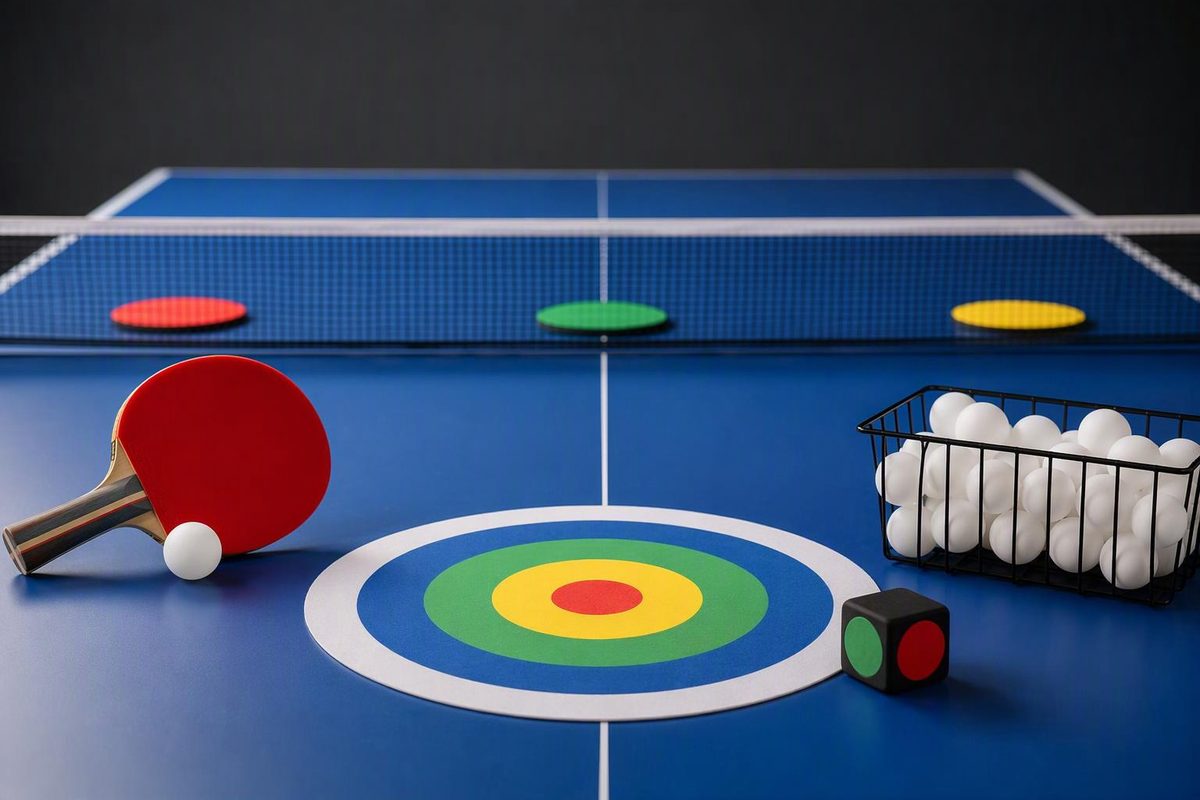
“Practice makes permanent” is useful only if it changes how you train. Repeating a poor contact, recovering late or succeeding only against a predictable feed can make that version of the skill habitual. The answer is not to avoid repetition; it is to make each repetition produce information.
This 45-minute partner session trains one club-level pattern: short backspin serve, long push, controlled third-ball attack. It combines spin, placement, movement and recovery without turning the drill into unstructured match play.
What you need
Setup: One partner is required. A robot cannot receive your serve and choose a realistic return, so it is not a full substitute for this session.
Bring:
- 20–40 balls
- two flat target markers or sheets of paper
- a timer
- a score sheet
Put one target deep on your partner’s backhand side and the other deep at the playing elbow—the area where the receiver must choose between forehand and backhand. Keep the markers flat and away from the table edge.
Use one short, heavy-backspin serve you already understand. If that serve is not yet stable, work through the mechanics in Spin Serves: Your First Three before adding the third ball. Check that every repetition also satisfies the legal service checklist.
Why a strong final block can mislead you
A good last five minutes shows how you performed at the end of practice, not necessarily what you will retain. The Australian Sports Commission describes skill acquisition as covering acquisition, performance and retention, and it identifies skill tests as a way to measure performance and learning (Clearinghouse for Sport).
Do not judge the session only by your best streak. Use a fresh test after the technique block, then repeat it at your next session to see what remains available.
The 45-minute session
0–5 minutes: Warm up the exact movement
After your general warm-up, shadow the pattern without a ball:
- Take your service position.
- Finish the serve balanced rather than leaning over the table.
- Recover to a neutral position.
- Split-step as the receiver would contact the push.
- Move to the ball, play a compact opening stroke and recover again.
Do six slow repetitions and six at playing speed. Use one outcome cue: “Serve short, attack deep, recover for the block.” This is an external focus because it directs attention toward the intended effects of the movement rather than individual body parts. A meta-analysis found external-focus instructions more effective than internal-focus instructions across performance, retention and transfer outcomes (Psychological Bulletin abstract).
5–10 minutes: Record a no-coaching baseline
Play 10 repetitions:
- Serve short with backspin.
- Your partner pushes long to either half of the table.
- Attack toward either target.
- Your partner blocks once to any reachable position.
- Control that ball onto the table.
Score one point for each condition:
- Serve: your partner judges that it would bounce twice on the receiver’s side if left untouched.
- Attack: the third ball lands on or within one racket length of a target.
- Recovery: you return the partner’s block.
The maximum is 30. Record the three scores separately. “18/30” is less useful than “serve 8, attack 7, recovery 3,” because the component scores identify what to practise next.
10–20 minutes: Correct one weak link
Choose the lowest baseline score. Work on that condition without changing everything else.
If the serve is weak: Hit three sets of six serves without a return. Count only legal serves that satisfy the short-placement test. Use one cue, such as “first bounce near my end line” or “keep the second bounce on the table.”
If the attack is weak: Your partner gives the same long push to one location for three sets of six. Aim at one deep target with controlled pace. The goal is a reliable opening ball, not a winner.
If recovery is weak: Play the full pattern, but make the third ball slower. Your partner blocks once at random. Count only repetitions in which you regain balance and return the block.
After each set, make one adjustment. A target hit provides knowledge of results; a phone clip or partner comment about the movement provides knowledge of performance. Both are forms of augmented feedback—information added to what you can sense for yourself (systematic review). Avoid stacking several technical instructions onto every ball.
20–32 minutes: Rebuild the whole pattern
Play four sets of five repetitions. The receiver pushes to a declared location for the first two sets and either half for the last two.
Before each set, state one outcome cue:
- “Second bounce stays on the table.”
- “Clear the net safely and land deep.”
- “Recover before the block.”
Pause for 20–30 seconds between sets. Record serve, attack and recovery scores separately. If one component falls below 2/5 for two sets, simplify the feed and restore predictability before trying the variable return again.
32–40 minutes: Add uncertainty
Play eight points from the same serve. Your partner may:
- push long to either half;
- push short; or
- flick if the serve drifts long or high.
Play the point out. Award yourself one pattern point only when you serve legally, make an appropriate third-ball choice and recover for the next ball. Do not force a short return into the rehearsed long-push pattern; recognize it and choose a suitable short-ball response.
This phase will probably produce more errors than the predictable drill. Research on contextual interference compares blocked repetition with random or interleaved practice. Meta-analyses favor higher-interference practice for retention and transfer overall, but results are less clear in applied settings than in laboratory tasks (retention review; transfer review). Use variation to test recognition and decision-making, not as a guaranteed shortcut.
40–45 minutes: Retest without intervention
Repeat the original 10-ball baseline. Do not stop for coaching, video review or technique changes. Compare the three component scores with the opening test.
Write down:
- the lowest component score;
- the cue associated with the clearest improvement;
- the error that returned under uncertainty;
- the first drill for your next session.
Run a next-session retention check
At your next session—ideally 24–48 hours later—perform another 10-repetition baseline before extra practice. This interval is a practical schedule, not a rule: the important point is to test after a delay rather than relying only on your score at the end of today’s session.
Use the same serve, targets, scoring and partner instructions. If possible, ask the same partner to return so that the comparison is reasonably consistent.
Treat a correction as promising if it survives the fresh test. If it disappears, reduce the difficulty, restore one clear outcome cue and build the pattern again. The aim is not merely to complete more repetitions, but to make the right serve, attack and recovery available when the next return is no longer guaranteed.