
Should You Use a Two-Handed Backhand in Table Tennis?
A two-handed backhand is legal in table tennis, but is it useful? Compare its control, coverage and forehand recovery in this 35-minute test.
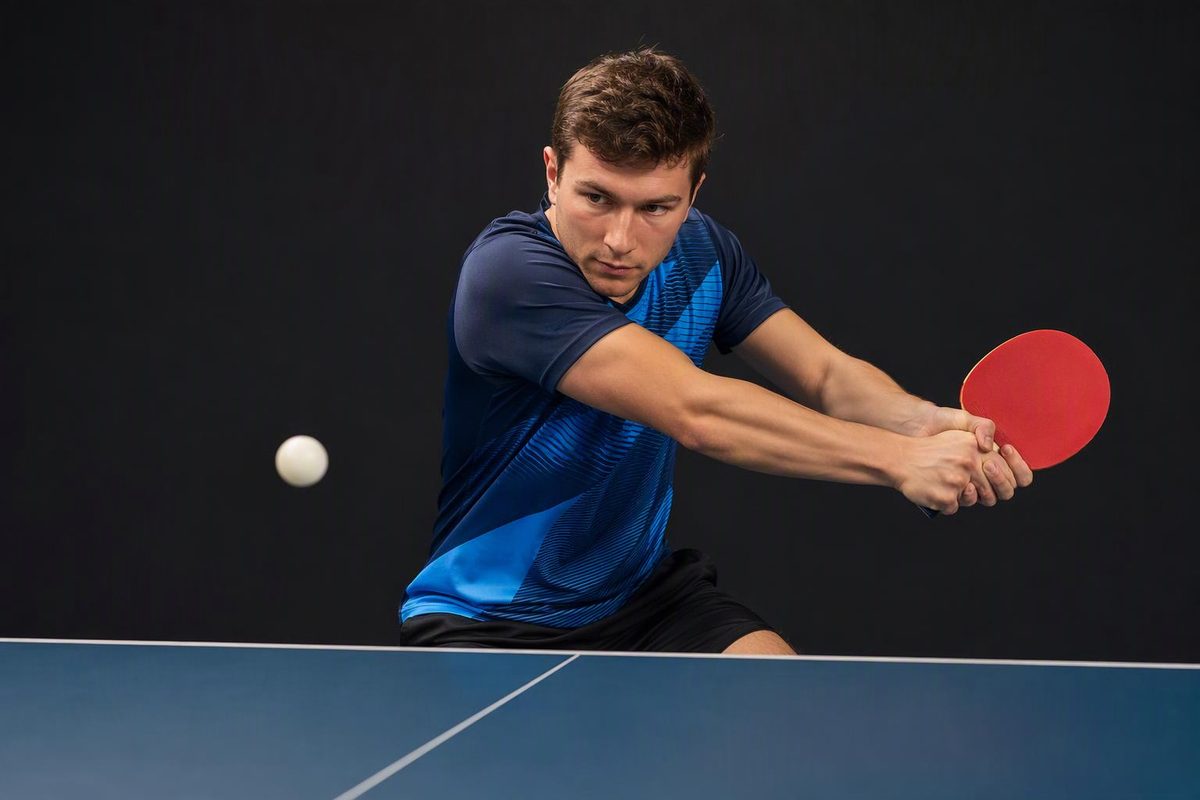
A two-handed backhand is legal in table tennis, but it is rarely the best default stroke. It may feel stable—especially if you come from tennis—but it also ties both arms to one contact point and adds a release before the next forehand.
Build a compact one-handed backhand first. If two hands still feel useful, run the comparison session below rather than judging the stroke from a few cooperative rallies.
Is a two-handed backhand legal?
The ITTF laws do not expressly name a two-handed backhand. They define the racket hand as the hand carrying the racket and a strike as touching the ball with the racket while it is held in the hand, or with the racket hand below the wrist. Nothing in those definitions prohibits the other hand from supporting the racket during a rally (ITTF Statutes 2026, laws 2.5.5–2.5.7).
Service is different. It must begin with the ball resting on the open palm of the stationary free hand; after projecting the ball, the server must remove that arm and hand from the space between the ball and net. The simplest legal approach is to serve normally with one hand and add the supporting hand only after the serve has been struck (ITTF Statutes 2026, laws 2.6.1–2.6.5).
There is also a high-level example. A report on Hugo Calderano’s 2025 World Cup semifinal against Wang Chuqin notes that Calderano played a two-handed backhand early in the final rally. The report describes one improvised shot, not Calderano’s normal backhand technique (Butterfly’s match report).
Why one hand should be your baseline
Standard table-tennis instruction teaches a one-handed backhand drive and topspin. For a basic drive, the racket begins in front of the body, travels forward and slightly upward, contacts the ball in front near the top of the bounce, and returns to ready position. The elbow and forearm produce most of the movement (backhand-drive coaching points from Expert Table Tennis). The ITTF foundation series also includes the backhand drive and backhand topspin among its core techniques (ITTF Education).
A second hand can add a feeling of support, but test what it does to these four areas:
- Coverage: Can you still reach the wide backhand and the playing elbow—the crossover point between forehand and backhand—without leaning?
- Racket adjustment: Can you change the racket angle for different spins without fighting the supporting hand?
- Forehand transition: Can you release the second hand and recover before the next ball?
- Contact position: Does the ball stay in front of your body, or does a tennis-style turn pull contact beside you?
If instability is the reason you want two hands, check your table-tennis grip first. Coach Larry Hodges recommends a small increase in thumb pressure for the backhand, creating a subtle grip adjustment that supports and slightly closes the racket without adding another hand (Butterfly).
A 35-minute comparison session
Equipment: A partner or programmable robot, plus two targets. Use controlled, medium-paced balls with light topspin. Place one target in the opponent’s backhand corner and one near the middle.
Keep the test fair: Use the same feed speed, placement sequence and target for both techniques. Record results as successful returns out of 20 or as percentages.
1. Establish the one-handed pattern — 7 minutes
Play three sets of 20 backhand drives.
- Stand roughly an arm’s length from the table with bent knees.
- Keep your chest facing the incoming ball.
- Start the racket in front of your abdomen with a slightly closed angle.
- Contact in front, near the top of the bounce.
- Finish forward and slightly upward, then recover immediately.
For each set, record balls landing on the table, balls hitting the chosen target and late recoveries.
Checkpoint: Deliberately let one feed pass. It should travel toward the center of your chest. If it passes beside you, move your feet behind the ball instead of reaching across your body.
2. Test the two-handed version — 7 minutes
Play three sets of 20 from the same feed. Keep your normal racket-hand grip unchanged. Add only light support at the base of the handle or against the racket hand; keep the supporting fingers away from the racket’s playing surface.
Use the same compact forward-and-upward path. Avoid a long tennis backswing or a side-on body turn.
Record the same three measures: successful returns, target hits and late recoveries. Stability only counts if you preserve placement and return to ready position.
3. Measure the forehand transition — 10 minutes
Ask your partner or programmable robot to send two balls to the backhand followed by one to the forehand.
Complete 10 three-ball sequences with a one-handed backhand, then 10 with two hands. In the two-handed set, release the support as soon as the backhand follow-through ends.
Score a sequence only when all three balls land and you finish balanced after the forehand.
Checkpoint: Watch the third ball. A trapped elbow, late release or unfinished grip change shows that the supporting hand is interfering with recovery.
4. Add uncertain placement — 8 minutes
Use a fixed batch of 40 feeds placed unpredictably between the wide backhand and playing elbow. Play every ball with a backhand. Complete one batch with one hand and one with two, keeping the feed rate unchanged.
Count successful returns and target hits. Also mark any ball that forces you to lean because your feet or arms cannot create a comfortable contact point.
This test is more informative than repeating one feed because it measures whether the stroke survives a changing contact location.
5. Make the decision — 3 minutes
Compare:
- return percentage in the controlled sets;
- target percentage;
- completed backhand-to-forehand sequences;
- return percentage under uncertain placement.
Keep the one-handed backhand as your default unless two hands produce comparable placement, coverage and forehand recovery—not merely better control from one stationary position.
If the two-handed version remains competitive across all four measures and causes no discomfort, keep testing it with a coach or practice partner under serve-and-rally conditions. Otherwise, treat Calderano’s example for what it was: evidence that the shot can be improvised legally, not a reason to replace the compact one-handed backhand.