
Ping Pong Doubles: Move Together, Set Up Your Partner
Practise ping pong doubles with a 30-minute, four-player session covering hitting order, movement, serve placement and returns that help your partner.
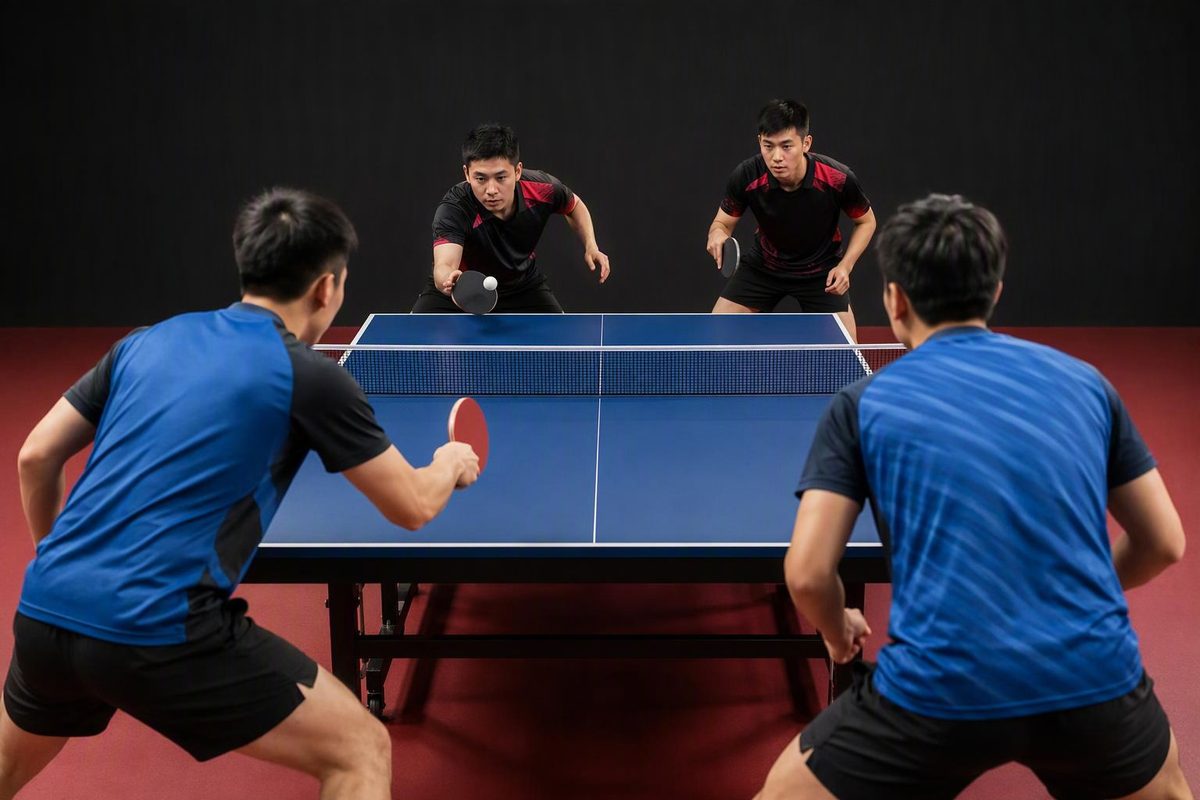
In ping pong doubles, your recovery needs to make room for your partner—not just prepare you for your next shot. Start with a simple pattern: hit, step back, let your partner enter, then recover for your turn.
This 30-minute session needs four players, one table and several balls. It focuses on clearing space and choosing serves and returns your partner can use. A robot can help with individual strokes, but this session needs live partners to practise the movement exchange. Leave enough clear space behind and beside the table, and keep loose balls out of your movement paths.
The rules you need before starting
For standard standing doubles:
- Serve right half to right half, viewed from each player’s end. The centre line counts as part of the right half-court. After the serve, returns can land anywhere on the opposing court. Neither the server nor their partner may hide the ball from the receiver during service.
- Alternate every shot within your pair. If A and B play X and Y, and A serves to X, the rally order is A → X → B → Y → A, repeating. You cannot take your partner’s ball because it is closer to you.
- Service changes after two points, or after every point from 10–10 onward. The previous receiver becomes the server; the previous server’s partner becomes the receiver. In that example, the service pairings are A to X, X to B, B to Y, then Y to A.
- Play to 11, winning by two.
These follow the 2026 ITTF laws reproduced by Table Tennis England, sections 2.1.6, 2.6–2.8, 2.10–2.11 and 2.13. Wheelchair doubles has exceptions to the alternating-shot rule. For the full rotation and deciding-game changes, see doubles rules in table tennis.
Positioning: clear the hitting space, not the whole court
Begin with in-out movement, rather than trying to run a large circle around your partner:
- Play your shot and step back out of the immediate hitting space.
- Watch where your partner moves; clear to the opposite side without drifting unnecessarily far away.
- As your partner withdraws after contact, move forward for your next ball.
This follows the accessible movement pattern described in TableTennisCoaching.com’s doubles footwork guide. The guide also explains circling footwork, but notes that it needs substantial practice and two mobile players.
For a right-handed/left-handed pair, start by testing the right-hander on the left and the left-hander on the right, viewed from behind your end. For two right-handers, test the stronger forehand player on the left and the stronger backhand player on the right. Reverse that starting arrangement for two left-handers. These are starting positions, not fixed territories: whoever is due to hit must reach the ball.
Checkpoint: your partner should be able to step toward the incoming ball without going around your body. If they repeatedly hesitate behind you, slow the drill and shorten your recovery path.
A 30-minute doubles session
The targets below are practice goals, not performance standards. Keep one tally for wrong-order hits and one for movement problems—blocked paths, collisions or a partner forced to wait.
0–5 minutes: cooperative rally and recovery
Use A → X → B → Y as the hitting order. Start with gentle topspin or blocks toward the middle of each court. Avoid wide angles while learning the movement.
After each hit, use the in-out pattern. Keep watching the ball while clearing space; do not turn away and jog around your partner.
Target: complete three rallies of eight consecutive legal contacts without blocking a partner. If that is too difficult, aim for four contacts first.
5–13 minutes: serve for your partner’s third ball
Use four two-minute blocks: A serves to X, X to B, B to Y, Y to A. These are timed practice blocks, not match scoring.
In each block:
- Serve short backspin into the legal right half, near the centre line but with a comfortable margin.
- The receiver pushes long toward the middle.
- The server’s partner plays a controlled opening topspin—the third contact of the rally—or a balanced push if they cannot attack reliably.
- Stop and reset.
Agree on the serve before starting. Your partner should know both the intended spin and placement.
Coach Tom Lodziak recommends short serves toward the middle as a containing doubles option, while emphasising that serve choice should suit your partner’s preferred rally. It is a starting pattern, not a guarantee of a weak return.
Checkpoint: on occasional unreturned test serves, check whether the ball would bounce twice on the receiver’s side if untouched. During live attempts, record whether the server cleared space and the partner reached the third ball balanced. Count that separately from whether the attack landed.
13–21 minutes: receive, then make room
Repeat the same four service pairings in two-minute blocks. Keep the serve predictable, but now continue through the fifth contact:
serve → receive → server’s partner → receiver’s partner → server.
The receiver pushes long toward the middle, then immediately clears space for their partner’s fourth-ball shot. Keep subsequent strokes controlled enough to complete the sequence.
Target: complete five clean five-contact sequences in each block. If a receiver admires their return and stays at the table, stop, rehearse the exit without a ball, then restart.
21–30 minutes: scored points with a team check
Use normal scoring to 11 and the correct service rotation. Before each serve, briefly agree on spin and placement. Between points, discuss only one actionable adjustment, such as “give me more room after the push.” At 30 minutes, finish the current rally; an unfinished game is fine for this drill.
Keep the two tallies alongside the score. If you play at least 20 rallies in this block, compare the first ten with the last ten:
- Did wrong-order hits decrease?
- Did fewer returns leave a partner blocked or waiting?
- Which serve let the partner play the third ball from a balanced position?
If you play fewer rallies, use the tallies to identify the most frequent problem rather than judging improvement. Use that problem to choose your next session. If movement is clean but serves keep drifting long, work on serve technique and a 15-minute solo drill before adding more doubles patterns.