
Practise Your Ping-Pong Backhand: A 25-Minute Session
Learn backhand drive technique, choose between a drive, block and push, and practise placement and footwork with a 25-minute partner or robot session.
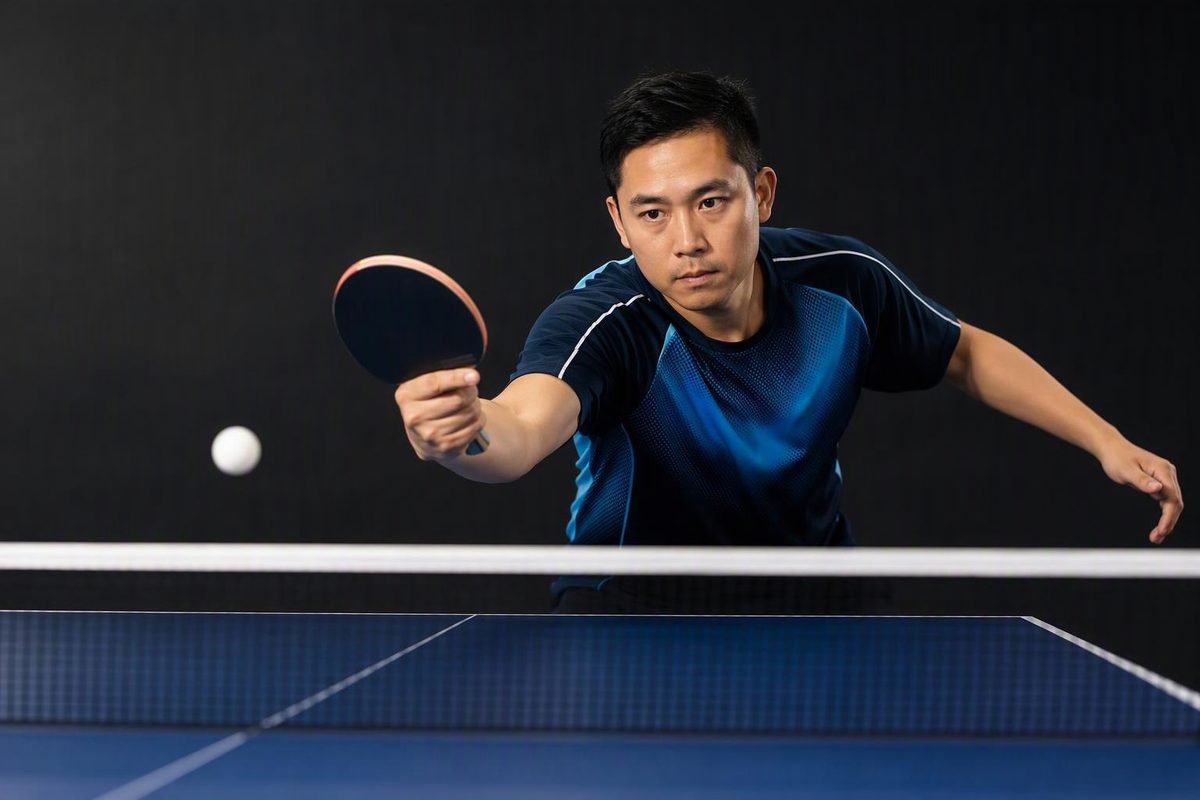
For a shakehand player, the basic backhand is played in front of the body, with the back of the racket hand facing the opponent. It usually covers the left side for a right-hander; left-handers mirror this.
Start with the backhand drive: a forward stroke with a little topspin for controlled attacking rallies. This session trains contact, placement and recovery—not maximum power.
You need: a table, racket and a partner or robot. The instructions assume a shakehand grip and ordinary inverted rubber—the smooth-surfaced type. For penhold-specific instruction, see the separate reverse penhold backhand guide.
Choose the right backhand stroke
“Backhand” describes a family of strokes, not one swing you should use against every ball.
- Drive: use it against a comfortably reachable, medium-length or long topspin or no-spin ball. Move the racket forward and slightly upward. These are the starting feeds in Ben Larcombe’s backhand drive breakdown. For this session, avoid backspin feeds: coach Tom Lodziak explains that low, heavy backspin needs a lifting topspin stroke rather than the basic backhand drive.
- Block: use a shorter action against a fast topspin attack, meeting the ball on the rise. Adjust the closed racket angle to the incoming spin rather than adding a full drive swing. See Martin Hughes’s blocking technique guide.
- Push: a controlled option against backspin. Open the racket face and brush underneath the ball with a smooth action, as explained in Lodziak’s backhand push lesson.
Build the drive first. Treat the more forceful backhand punch as a separate progression, not your default rally stroke.
Backhand drive technique
1. Get behind the ball
Stand close to the table with feet slightly wider than shoulder width, knees bent and weight forward. Keep the racket in front of you. Move your feet so contact happens in front of your torso rather than reaching sideways.
Checkpoint: there is room between your elbow and body; the ball is neither crowding your stomach nor pulling your arm fully straight.
2. Prepare a slightly closed racket
Bring the racket back toward your waist or belly button. “Closed” means the playing face tilts slightly toward the table. Start with a steady wrist rather than trying to create speed with a large wrist flick.
3. Move forward and slightly up
Use mainly the elbow and forearm to move the racket toward the ball. Meet it near the top of the bounce, in front of your body. Make a solid contact with a small upward component—do not chop down or scoop underneath it.
4. Finish and reset
Follow through toward your target, then return the racket to the ready position. Avoid sweeping it far across your body.
These cues follow Larcombe’s backhand drive breakdown, which emphasises forearm-led movement, peak-of-bounce contact and recovery. If your grip makes the racket angle awkward, check your shakehand finger placement before changing the swing.
A 25-minute backhand session
Use gentle, repeatable topspin or no-spin feeds that bounce far enough out for a drive. Set the robot’s interval slowly enough to reset between balls. With a partner, begin backhand-to-backhand or use multiball: the feeder sends individual balls from a basket.
Define targets by the table’s centre line rather than placing objects on the playing surface. The scores below are practice goals, not standards you must meet before progressing.
Minutes 0–3: Find comfortable contact
Play slowly into your partner’s backhand half. With a robot, aim diagonally into the opposite half.
Focus only on getting behind the ball and meeting it in front. If you are cramped or reaching, adjust your position before changing the racket angle.
Minutes 3–10: Build repeatability
Keep the feed in one location. Count your longest run of successful drives; with multiball or a robot, count consecutive landed returns.
Try to reach ten controlled returns without increasing speed. Then score one set of 20 balls, aiming for 16 landed returns. Count only usable feeds: balls of the agreed spin, length and placement that you can reasonably drive.
Minutes 10–16: Add placement
Play five balls diagonally, then five down the line. Repeat, keeping the same moderate pace. Diagonal means across to the opposite corner; down the line means roughly parallel to the sideline.
Use multiball here, or have your partner return both placements to your backhand. If that is difficult, restart each ball rather than forcing a continuous rally.
Score both landing and placement: a ball on the table but outside the chosen half is not a target hit. Aim for eight target hits in ten before adding speed.
Minutes 16–22: Move, hit, recover
Ask your partner to alternate feeds between your usual backhand position and a spot slightly nearer the middle. Keep both locations comfortably playable with a backhand.
Take a small sideways step, settle, hit and reset. Use alternating two-position placement if your robot supports it. With a fixed-head robot, practise short sets at each location, resetting your stance between sets; this trains positioning, not movement between successive balls.
Checkpoint: contact stays in front of your torso at both positions. Reduce the spacing if you start reaching or losing balance.
Minutes 22–25: Test without a fixed pattern
Ask your partner to vary placement within that same backhand area without announcing the destination. Choose one target half for your returns. Score the first 20 usable feeds for successful returns and target hits.
With a robot, use random placement within that area if available; otherwise repeat the fixed 20-ball test. Record the feed mode, spin, pace, placement and target. Compare scores only under similar conditions. Fixed robot feeds test execution, not your ability to read an opponent.
Fix one error at a time
| What you see | What to check next |
|---|---|
| Repeated net balls | Confirm the feed is not backspin; check that you are moving forward and slightly up, not down. |
| Balls flying long | Reduce swing speed and check whether the racket face opens during contact. |
| Contact beside your body | Move behind the incoming ball instead of extending your arm. |
| First ball works, next ball fails | Check whether your follow-through is delaying the reset. |
Finish by noting your 20-ball score and one cue to keep next time—for example, “contact in front, then reset.” Change only that cue during the next controlled set.