
Build a Fast, Compact Backhand Punch
Learn to choose the backhand punch, set the racket angle, contact near the bounce peak, and build control with a focused 30-minute table tennis drill.
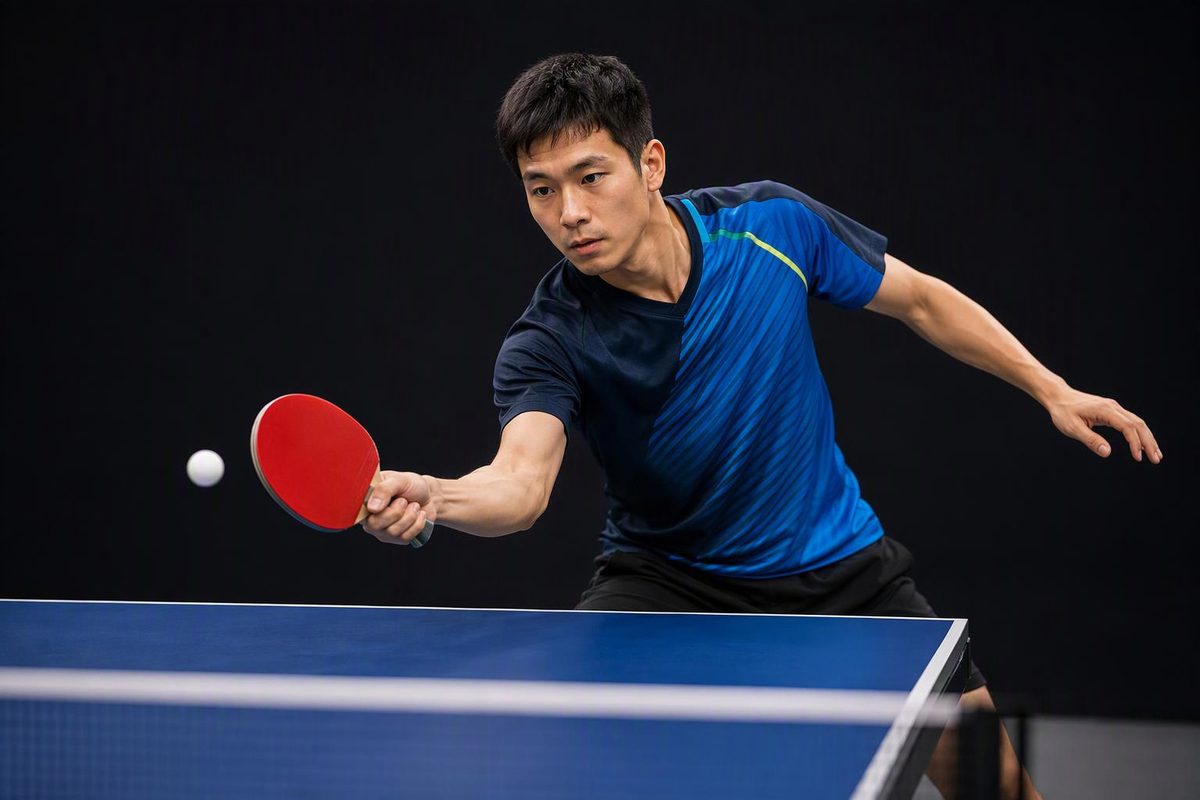
The backhand punch is a compact attack for a weak ball that rises high enough on your backhand side. Use a short preparation and accelerate directly through the back of the ball for speed and a flatter flight. Do not force it against a low ball, heavy backspin or a fast attack; block, push or loop instead.
Choose the incoming ball; the selector shows whether to punch, block or use another stroke.
Backhand Stroke Selector
Classify the ball at contact, not where the rally began.
Recommended Stroke
Backhand punch
The default ball is deep or half-long, above net height and weak enough to attack directly.
Action: Use a short preparation, contact near the bounce peak and accelerate forward through the ball.
Stroke distinctions follow the coaching guidance cited in the article from Craig Bryant and Butterfly.
In coach Craig Bryant’s demonstration, the punch is an attacking shot for a ball that “pops up a little high,” using a forearm-and-wrist snap through the back of the ball (Tom Lodziak Table Tennis Coaching). The height gives you room to hit forward without having to lift the ball strongly.
Match the Stroke to the Incoming Ball
Coaches do not always use punch, punch block and punch flip identically. The incoming ball provides the clearest distinction:
- Backhand punch: Attack a weak, deep or half-long ball that sits high enough to hit forward.
- Punch block: Add a short forward acceleration to an opponent’s topspin while staying close to the table. Butterfly distinguishes this higher-risk stroke from an active block, which adds only modest pace and topspin (Butterfly).
- Punch flip: Attack a short, high ball over the table with a direct backhand action. A Butterfly demonstration contrasts the punch flip for high balls with the banana flip for low balls (Butterfly).
Learn the basic punch against a predictable weak feed that rises above net height. Do not begin against heavy backspin or a fast loop.
Set a Stable Base Near the Table
Stay close enough to take the ball near the top of its bounce. Keep your feet a little wider than shoulder width, flex your knees and hold the racket in front of your torso.
Make a small adjustment step when needed rather than reaching. Butterfly’s blocking guide emphasizes foot adjustment and a stable base, noting that poor balance can send blocks beyond the table.
If your grip makes the backhand angle uncomfortable, check your finger position before rebuilding the stroke. Start with the neutral shakehand position in this table tennis grip guide.
Keep the Preparation in Front
Bring the forearm back only a short distance. Keep the elbow slightly forward and away from the ribs so the forearm can extend. Do not let the racket drop below the table.
The compact preparation lets you contact on time and recover. If the racket travels behind your torso, the swing is already too large for this stroke.
Shadow the stroke and pause just before contact. The racket should remain in front of your body, with enough room between your elbow and ribs for the forearm to move forward freely.
Set the Racket Angle From the Spin
Use an almost vertical racket against a gentle no-spin feed, then adjust from the result. Close the face more against topspin. Backspin requires a more open face and an upward component; unless the ball is clearly high, a loop or push is the safer choice.
Do not change the racket angle as the forearm starts forward. A stable face makes the direction repeatable and lets you diagnose misses. If the angle keeps moving through contact, reducing the swing and wrist action is more useful than adding speed.
Contact Near the Top of the Bounce
Accelerate the forearm forward from the elbow and strike through the back of the ball. Keep the hand relaxed in preparation, firm the grip briefly around contact and finish with the racket in front of you.
Begin with little deliberate wrist action. Once you can hold the racket angle and control direction, add a sharper forearm-and-wrist action for speed. The follow-through should travel generally toward the target rather than sweeping across your body.
Look for a direct, low arc and a compact finish. If the ball floats, check the incoming spin, contact quality and racket angle before swinging harder. If it repeatedly goes long, close the face slightly or shorten the action.
Recover Before the Next Ball
Stop the follow-through before the arm locks straight. Return the racket to a neutral position and reset your legs. A punch is useful only if you are ready for the next ball.
This recovery also reveals whether the stroke is genuinely compact. If you cannot reset before the next feed, reduce the backswing, forward swing or both.
Train the Backhand Punch in 30 Minutes
A partner is best because they can vary the feed and continue into a point. A robot works for the technique and placement stages; use light topspin or no-spin at a comfortable pace.
Put one target deep in the backhand corner and another near the opponent’s playing elbow. The elbow is the crossover area where the opponent must choose between forehand and backhand.
0–5 Minutes: Establish the Timing
Play controlled backhand blocks at about half pace.
- Aim for 20 consecutive returns.
- Adjust your feet before contact when necessary.
- Keep every finish in front of your torso.
This establishes timing without demanding punch speed.
5–13 Minutes: Punch to the Backhand Target
Feed a slightly high, predictable ball to one backhand location. Punch cross-court at 60–70% of your available speed.
Play four sets of 10. Count a success only when the ball reaches the deep target and you recover before the next feed.
Do not add pace until you reach 7 controlled target hits out of 10. If the score falls after you accelerate, return to the previous speed rather than accepting a larger swing.
13–21 Minutes: Decide Between Block and Punch
A partner mixes two feeds:
- Lower or faster topspin: active block.
- Weaker ball above net height: punch.
Call “block” or “punch” just before contact. Play four sets of 12 and record correct choices separately from successful returns. A correct choice followed by a miss and a poor choice that lands should not receive the same score.
If you punch everything, make the feeds slower and more distinct. The purpose is to recognize the available ball, not to disguise the feed immediately.
With a robot that cannot randomize height, speed or spin, alternate one set of blocks and one set of punches instead. A predictable sequence can train technique, but it is not a decision drill.
21–27 Minutes: Alternate Two Placements
Punch one ball wide to the backhand and the next toward the playing elbow. Play three sets of 10.
Reduce speed until at least 7 of 10 balls reach the intended target. A faster shot to the wrong place does not count. Keep the same compact action for both directions and make the directional change with your setup and racket path rather than a late wrist movement.
27–30 Minutes: Test the Stroke in a Rally
With a partner, start from a serve or simple feed. The feeder sends the first available weak ball to your backhand; punch it and continue the rally freely. Record the punch choice, placement and outcome rather than counting only winners.
With a robot, randomize placement across your backhand half if possible. Play the appropriate block or punch, then shadow your recovery for the next ball. Score 20 feeds for correct choice and target accuracy.
For a fuller method of testing a pattern under variable returns, use Practice Makes Permanent.
Correct the Miss Before Adding Speed
| Miss | Likely Cause | Next Adjustment |
|---|---|---|
| Ball flies long | Open racket, excessive swing or unrecognized topspin | Close the face slightly and shorten the finish |
| Ball hits the net | Closed racket, late contact or more backspin than expected | Recheck the spin and meet a suitable ball nearer its peak |
| Direction varies | Wrist changes the angle through contact | Quiet the wrist and send the forearm toward the target |
| Recovery is late | Follow-through travels too far or crosses the body | Finish in front and reset immediately |
| Stroke fails against faster topspin | Not enough time or height for the attack | Use an active block and wait for a weaker ball |
Build placement and recovery at moderate pace first. The useful backhand punch is not your hardest swing; it is a compact attack you can select and control under rally pressure.