
How to Serve in Ping Pong: Start Legal, Then Add Backspin
Learn a legal ping-pong serve, add controlled backspin, and practise placement with a focused 15-minute solo session.
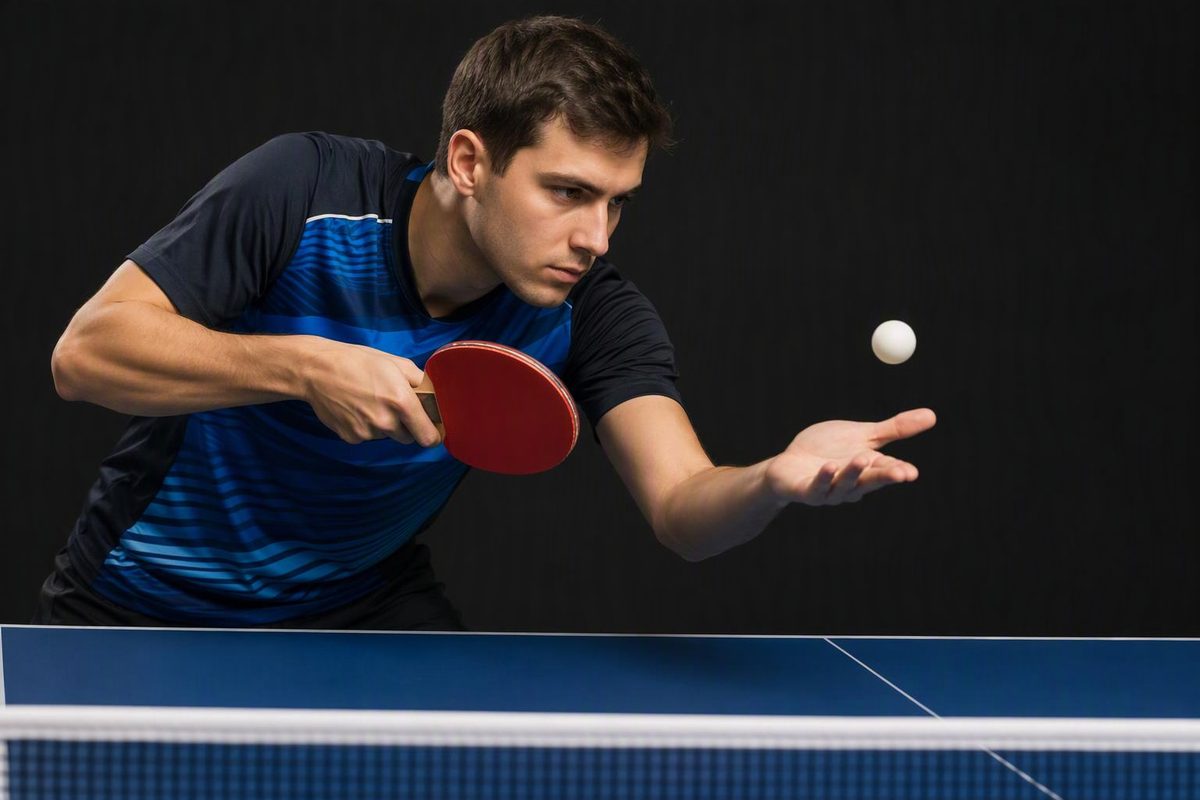
To serve in ping pong, toss the ball from an open palm, let it start falling, then strike it so it bounces on your side before landing on your opponent’s side. Start with a controlled serve; add spin once you can repeat the toss and contact.
Setup: A table with a net, your racket and 10–20 balls. The 15-minute session below is solo—no partner or robot needed.
Make the serve legal first
Use this sequence on every repetition:
- Start with the ball resting freely on your open, stationary palm. From this point until contact, keep the ball above table height and behind your end line.
- Toss near vertically upward, without adding spin. The ball must rise at least 16 cm after leaving your palm. That measures the rise, not its total height above the table.
- Move your free arm and hand out of the space between the ball and the net immediately after the toss. Do not hide the ball from the receiver.
- Strike the ball while it is falling, without letting it touch anything first.
- Make it bounce first on your court, then directly on the receiver’s court.
These are the service requirements in the 2026 ITTF laws reproduced by Table Tennis England, section 2.6.
In singles, you do not have to serve diagonally. In doubles, the ball must bounce on your right half-court, then the receiver’s right half-court. A net touch is a let—replay the serve—if the serve is otherwise correct. A failed serve normally loses the point; there is no tennis-style second attempt. These provisions appear in sections 2.6, 2.9 and 2.10 of the same laws. See the full serve-rule checklist for more detail.
Build a repeatable contact
Stand behind the end line with your feet comfortably apart and knees slightly bent. Leave enough room to swing without reaching around your body. Keep your grip relaxed rather than squeezing the handle.
First, practise the toss alone. Toss and catch the ball with your free hand. It should rise and fall in roughly the same corridor. If it travels sideways, fix the release before trying to rescue it with your racket.
For a simple forehand serve:
- Bring the racket back a short distance.
- Watch the ball descend toward your contact point.
- Use a compact forward stroke, sending the ball downward toward your half of the table.
- Finish balanced, then bring the racket back in front of you, ready for the return.
Try contacting relatively low, while still clearly above table height. Treat this as a technique cue, not permission to shorten the legal toss. Your first checkpoint is 10 serves with a similar contact point and bounce path, not maximum speed.
Add backspin, then shorten the serve
For backspin, turn the hitting face upward so you can brush under the ball. Keep the racket fairly flat rather than tilting its tip up or down, as PingSkills coach Alois Rosario advises for straight backspin. Use a compact brushing action under the ball, with a slight downward component, following his backspin advice.
Keep enough forward movement to carry the ball over the net. Avoid turning the action into a large downward chop.
For a short serve, aim for a ball that would bounce twice on the receiver’s side if left untouched. That is a length test, not an instruction for the receiver to wait. PingSkills explains this short-serve distinction.
Let practice serves run untouched and watch their length. Do not judge shortness from the first bounce alone; a double bounce also does not prove how much backspin you generated.
| What you see | Adjustment to test |
|---|---|
| Ball repeatedly hits the net | Add a little forward carry; check you are not brushing only downward. |
| Intended short serve runs off the far end | Reduce the forward impulse while keeping the brushing action. |
| Ball clears the net very high | Try a lower legal contact and adjust the racket angle. |
| Placement changes every time | Stabilise the toss and contact before adding wrist speed. |
A focused 15-minute solo session
Include ball collection within each block. Choose an imaginary target about the size of a sheet of paper for the first bounce on the receiver’s side. For the short-serve blocks, place that target near the net.
- Minutes 0–3: Toss control. Toss and catch, then make a few controlled serves. Check height, direction and visibility.
- Minutes 3–7: Reliable landing. Serve in sets of 10 to one target. Record legal serves separately from target hits.
- Minutes 7–12: Short backspin. Let each ball continue untouched. Count how many are legal, hit the target and bounce twice on the far side.
- Minutes 12–15: Placement test. Alternate between two short targets without changing your basic action. Recover to your ready position after every serve.
If basic serving is still unreliable, stay with the reliable-landing block rather than forcing the progression. For this drill, use 8 out of 10 serves meeting all the block’s requirements, without a net touch, as a practice target before shrinking the landing zone. Record which requirement fails most often and work on that next session. Once this serve is repeatable, progress to your first three spin serves.