
5 Table Tennis Skills to Train With Clear Targets
Try five table tennis skill development examples with solo, partner or robot setups, clear practice targets and checkpoints you can repeat.
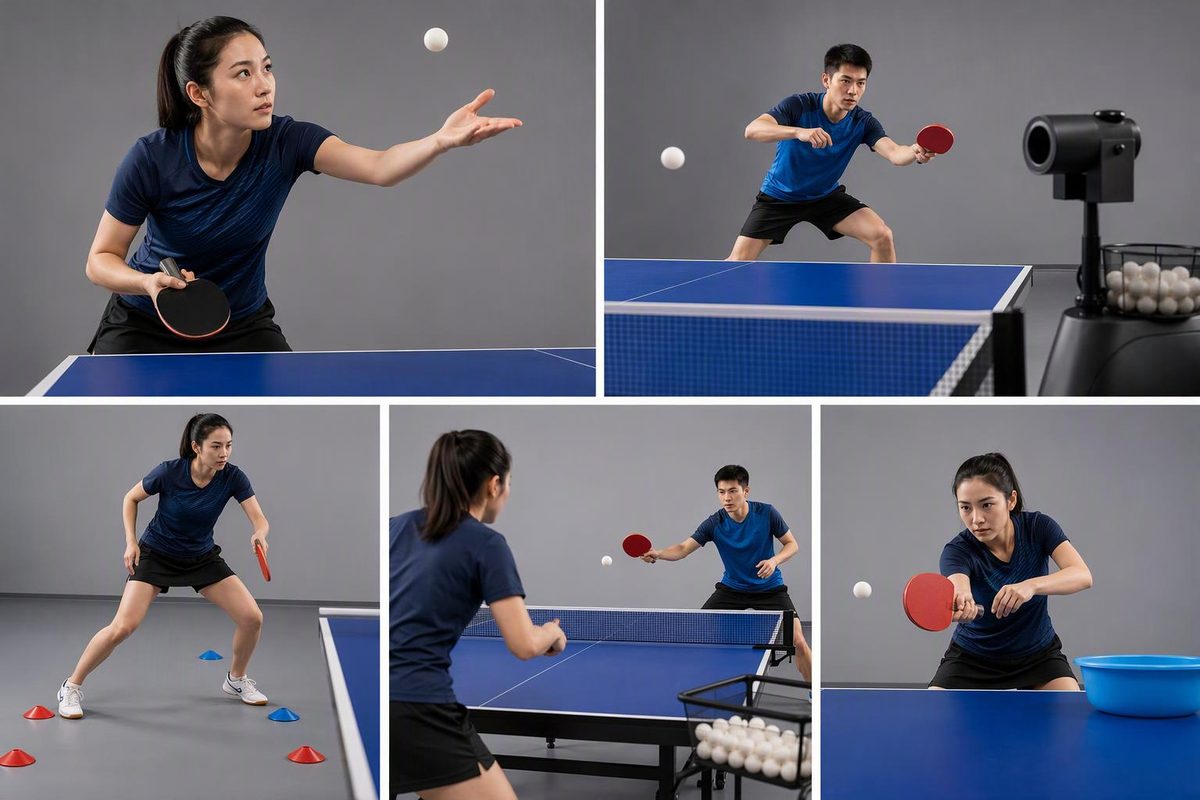
Useful skill development examples turn “get better” into something you can observe: a serve that stays short, a backhand that reaches its target, or feet that get you into position before contact.
The five examples below give you a setup, an action and a checkpoint. Choose one for your next session rather than rushing through all five. The suggested scores are practice targets, not official standards or promises of improvement.
1. Keep a backspin serve short
Needs: Solo access to a table, a racket and a box of balls.
Skill change: From an unpredictable serve length to a backspin serve that stays short in a chosen area.
A short serve would bounce at least twice on the receiver’s side if left untouched. Coach Larry Hodges describes practising this with an open racket and a brushing contact underneath the ball, keeping the serve low over the net. See his short-serve guidance.
Action: Choose the receiver’s forehand half or backhand half as your target. Serve ten balls with nobody returning them. Count a success only when the first receiver-side bounce lands in that half and the ball bounces a second time on the receiver’s side before leaving the table. Keep the chosen spin and placement constant while adjusting length. A target hit only counts if the serve is legal; use the serve-rules checklist to check your action.
Use one ball in your hand at a time, then recover to your ready position after each serve—both are recommendations in Tom Lodziak’s solo-service practice guide.
Checkpoint: Record successes out of ten. Once you reach seven in two sets, alternate between the two halves. This checks length and placement; it does not prove that the serve has heavy backspin. Later, ask a partner to receive it and assess the spin separately.
2. Place a backhand drive deliberately
Needs: A partner feeding consistently to your backhand, or a robot set to one placement and a manageable pace.
Skill change: From simply landing the ball to directing it into a chosen zone.
Action: Start with a comfortable backhand drive. Use the backhand drive technique guide if the stroke itself is not yet reliable.
Aim five shots into the left half of the far court, then five into the right half. Your partner should keep the incoming placement, spin and pace consistent rather than turning this into a footwork drill. With a robot, use the same feed settings throughout the test.
Checkpoint: Count target hits out of ten, not just balls on the table. If your shots land but miss the chosen half, reduce pace and retain the placement task. Progress by alternating targets every ball; increase speed only after you can control both directions.
3. Move between two forehand positions
Needs: A partner who can feed or block to two positions, or a robot with adjustable placement.
Skill change: From reaching sideways to moving into a balanced hitting position.
Action: Use two modestly separated locations on your forehand side: one near the middle and one wider. Play a forehand from each in a predictable alternating pattern, returning both to one comfortable area for your partner.
Move your feet between contacts rather than stretching your arm to cover the wider ball. Keep the spacing small enough that you can arrive without lunging. PingSkills recommends side-to-side practice and recovering to a balanced stance after each shot in its footwork guidance.
Checkpoint: Ask your partner to watch ten feeds. Count a success when the return lands and you finish balanced enough to move toward the next position. If you repeatedly reach or stumble, narrow the spacing or slow the feed. With a robot, record a short video to check balance rather than judging only where the ball lands. Once stable, widen the spacing slightly without increasing speed.
4. Choose forehand or backhand without a fixed sequence
Needs: A partner, or a robot capable of genuinely random placement.
Skill change: From following a memorised pattern to responding to the incoming ball.
Action: First rehearse a predictable backhand–forehand sequence at a comfortable pace. Then have most balls sent to your backhand, with occasional balls to your forehand, unannounced. Keep the spin and pace consistent so placement is the only new uncertainty. Play backhands from the backhand position and forehands from the forehand position, then recover.
PingSkills suggests starting with 80% of balls sent to a set position and 20% placed randomly, then increasing uncertainty as control improves. Read its randomisation guidance. The two-position version here is a simple starting task.
Checkpoint: Across twenty feeds, record balls returned and occasions when you committed to the wrong stroke or reached instead of moving. A robot alternating left-right predictably can train transitions, but it does not provide this same decision-making test. Increase the proportion of unexpected balls only while you can maintain control and balance.
5. Connect a serve to the third ball
Needs: A partner and a supply of balls.
Skill change: From serving and watching to preparing for the next shot. The third ball is the server’s first stroke after the receiver’s return.
Action: Serve backspin. Initially, ask your partner to push long to your forehand. Recover after serving, then play a controlled forehand topspin into a broad target, using the forehand loop against backspin guide if needed.
After a controlled set, let your partner choose a short or long push to the same forehand area without announcing it. Attack a suitable long ball; use a controlled push for a short ball rather than forcing the rehearsed loop. This short-push/long-topspin progression is also recommended in Alois Rosario’s guidance on practising variable push length.
Starting with serve and return follows the principle of PingSkills’ match drills: practise the skill within a point sequence.
Checkpoint: Across ten returns, record appropriate third-ball choices separately from successful shots. For this drill, that means a push against the short ball and a controlled topspin against a reachable long ball. A sensible choice followed by a miss needs a different adjustment from attacking the wrong ball.
Turn one example into a 20-minute block
Warm up first; the off-table warm-up routine is one option. Then use:
- 2 minutes: Take a baseline score using the example’s ten- or twenty-ball test.
- 8 minutes: Practise the controlled version, with brief pauses for feedback.
- 6 minutes: Add the example’s placement change or uncertainty. Stay with the controlled version if it is not yet stable.
- 4 minutes: Repeat the baseline test with the same number of attempts and original settings, then record the result.
For partner drills, run the block for one player, then swap roles. Log the target size, feed settings and score so your next-session test is comparable. Change one difficulty at a time: placement, speed, spin or unpredictability—not all four together.