
Turn Your Costliest Match Mistake Into a Training Plan
Turn lost points into focused table tennis practice. Use a 45-minute partner session, track match progress, or choose a solo serve or robot routine.
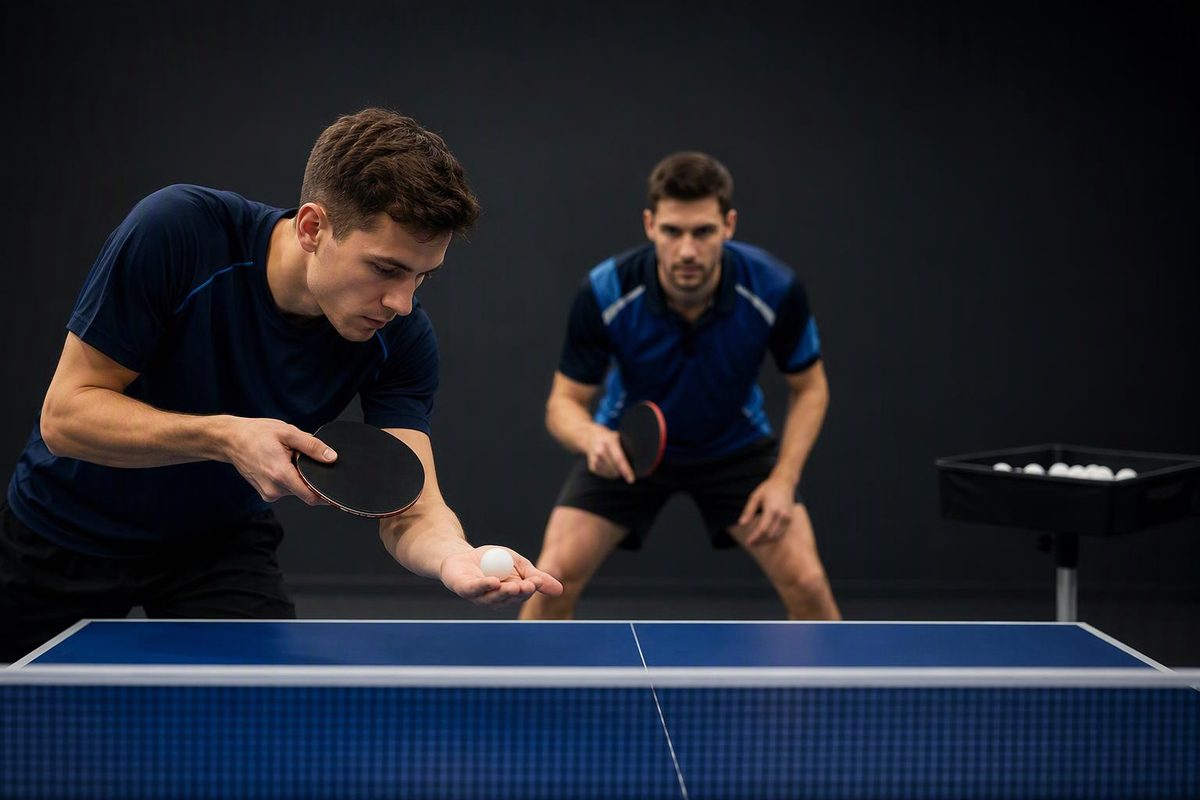
To get better at table tennis, identify a situation that repeatedly costs you points, practise it with a measurable target, then test it against unpredictable returns. Train serves, receive and movement—not just the stroke you already enjoy. Use the 45-minute partner session below to work on one weakness and check whether it improves in live points.
Choose your training setup to see the session you can run.
Choose Your Practice Session
Use one recurring match problem as your target.
Partner: 45-Minute Session
Train control and backhand-to-forehand movement, then test them after serve and receive.
| Block | Min | Record |
|---|---|---|
| Warm up | 5 | — |
| Controlled contact | 8 | Target hits / 20 feeds |
| Movement | 10 | Balanced target hits / 20 feeds |
| Serve and receive | 10 | Returns / attempts by serve type |
| Live points | 10 | Movement errors / opportunities |
| Log next task | 2 | One adjustment |
Role Changes and Progression
Split controlled contact into four minutes per learner, movement into five minutes per learner, and serve-and-receive practice into five minutes serving and five receiving. Timings include brief role changes and ball collection.
Start with predictable feeds. Add unannounced placement when you can stay balanced. These counts are practice measurements, not ability standards.
Solo: 20-Minute Serve Session
Choose one serve and a placement zone. Record placement and length separately.
| Block | Min | Task |
|---|---|---|
| Warm up | 5 | Shadow serve and recovery |
| Serve practice | 12 | Work in sets of 10 |
| Record results | 3 | Placement and length counts |
Check Short-Serve Length
Let the serve continue untouched. Check whether it bounces a second time on the receiver’s side. A serve can hit your placement zone without being short.
Add spin variation once placement and length are repeatable. This session does not test receive or live-rally decisions.
Robot: Control and Movement Practice
Use fixed placement first, then alternate two positions. A full robot-session duration is not specified in this guide.
| Stage | Feed | Check |
|---|---|---|
| Control | One position | Target hits / 20 playable feeds |
| Movement | Alternate two positions | Balanced target hits / 20 playable feeds |
| Uncertainty | Random, if supported | Stay balanced before adding difficulty |
What the Robot Does Not Test
Preset feeds do not provide an opponent’s serve-contact cues. Keep partner receive practice and live points in your schedule.
Reduce feed speed or spacing if you start reaching instead of moving.
Source: session plans in this guide. Timings and checkpoints are practice suggestions, not official ability standards.
Coach Tom Lodziak warns that too much stationary forehand-to-forehand practice can leave the rest of a player’s game underdeveloped. He recommends including irregular drills, serve-and-receive practice and matches in training.
The partner session needs one table, a partner, several balls and a notebook. Its 45 minutes include brief role changes and ball collection. Solo and robot alternatives follow.
Find the Problem Before Choosing the Drill
After your next match, review 20 points you lost, using video if available. Label each by the first problem you can identify:
- Serve: a fault or a serve the opponent attacked easily.
- Receive: a missed return or a high ball that invited an attack.
- Movement: reaching, getting crowded by the ball or recovering late.
- Stroke control: missing a ball you reached in a balanced position.
- Decision: choosing an attack or placement that did not suit the ball.
An opponent’s clean winner may not reveal a correctable error. Mark it separately rather than forcing a diagnosis.
Choose one recurring problem and turn it into an observable task. “Improve my forehand” is vague. “Move from backhand to forehand and land a controlled drive in the opponent’s backhand half” gives you something to practise and count.
If you cannot tell whether the fault is technique, positioning or spin judgment, show a short clip to a coach and ask about that specific situation.
Run a 45-Minute Partner Session
This example targets backhand-to-forehand movement and control, then tests that skill after serve and receive. Change the main drill if your match review identifies a different priority; the table tennis drill library offers other patterns. The numerical checkpoints are practice measurements, not official ability standards.
| Block | Time | Measurement |
|---|---|---|
| Warm up | 5 minutes | — |
| Controlled contact | 8 minutes | Target hits from 20 feeds |
| Movement and strokes | 10 minutes | Balanced target hits from 20 feeds |
| Serve and receive | 10 minutes | Returns by serve type |
| Live points | 10 minutes | Movement errors and opportunities |
| Log the next task | 2 minutes | One adjustment |
Warm Up for 5 Minutes
Start with easy movement and gradually add lateral steps and shadow strokes—stroke movements without a ball. Finish with gentle backhand and forehand rallies. Leave enough clear space around the table to move safely.
Establish Controlled Contact for 8 Minutes
Spend four minutes with each player as the learner. The partner blocks steadily to one position; the learner uses a familiar drive or block and aims into the partner’s backhand half.
Start slowly enough to complete several controlled shots. Keep the swing manageable and bring the racket back in front after contact.
Checkpoint: count target hits from 20 playable feeds. Record the result before increasing pace. If control is poor even without movement, simplify the stroke drill first; use the backhand technique and practice guide if that is your weak side.
Link Movement and Strokes for 10 Minutes
Give each player five minutes as the learner:
- The partner alternates a ball to your backhand and a ball to your forehand.
- Return both into the partner’s backhand half.
- Use a small sideways shuffle to create room, keeping your knees comfortably bent.
- Arrive balanced for contact, then recover for the next ball.
Start with modest spacing rather than chasing the widest corners. PingSkills’ footwork lesson emphasises a stable base before the shot and progressing from simple feeds to faster exercises.
Once the pattern is comfortable, have the partner send most balls to your backhand, with occasional unannounced balls to your forehand. PingSkills recommends beginning random practice with roughly 80% of balls to a set position and 20% random, then increasing uncertainty gradually.
Checkpoint: from 20 playable feeds, count balls that both reach the target and leave you balanced for the next shot. Reduce speed or spacing if you start reaching instead of moving.
Practise Serve, Receive and Recovery for 10 Minutes
Spend five minutes serving and five receiving.
As server, use a serve you already control—such as short backspin. Recover immediately after contact. Let your partner return naturally; play the next ball with a stroke you can control, then continue the point. The third ball is your first shot after the opponent returns your serve.
As receiver, ask your partner to begin with a known short backspin serve. Practise a push—a controlled backspin return—and recover. Then add a second familiar serve, such as long light topspin, before letting the partner choose between them without announcing it. Use a familiar drive or topspin return against the long light-topspin serve rather than automatically pushing both types.
PingSkills recommends purposeful serve practice, exposure to different servers and starting drills with a proper serve and return rather than an easy rally feed. Its serve-and-return guidance also recommends the push as a starting response to short backspin and topspin as the usual attacking option against long serves.
Checkpoint: tally successful returns and attempts separately for each serve type—for example, 8/10 short backspin. Count only legal serves that reach your side. For service mechanics, use the serve practice guide.
Test the Skill in Points for 10 Minutes
Play normal points with unrestricted serves and placement. Keep score, but also tally each backhand-to-forehand change and how many leave you reaching, late or off balance. Recording opportunities as well as errors makes the result more useful than an error count alone.
Do not force the trained pattern when the ball calls for something else. You are checking whether the skill survives uncertainty, not whether you can reproduce a rehearsed rally.
Log the Next Task for 2 Minutes
Write down your target-hit count, receive results and movement errors relative to opportunities. Choose just one adjustment for the next session: slower feeds, earlier recovery, smaller spacing or more varied placement.
Use Solo Time for Serves and a Robot for Movement
Run a 20-Minute Solo Serve Session
Spend five minutes warming up and shadowing your serve-and-recovery motion, 12 minutes serving, and three minutes recording results. Choose one serve and an imaginary placement zone. Work in sets of 10.
For a short serve, let the ball continue untouched and check whether it bounces a second time on the receiver’s side. PingSkills defines short serves by this two-bounce length.
Count placement and length separately: hitting the right half does not mean you kept the serve short. Add spin variation once you can repeat the intended placement and length. The first three spin serves guide provides a progression.
Use a Robot for the Control and Movement Blocks
Start with a manageable feed rate and fixed placement, then alternate two positions. Add random placement only if the machine supports it.
A preset feed does not provide an opponent’s serve-contact cues. Keep partner receive practice and live points in your schedule rather than treating robot success as proof that you can handle an opponent’s serve.
Increase Difficulty When Control Carries Across Sessions
If your schedule permits, try two focused sessions and one match opportunity each week. At the next session, repeat the same 20-ball test after warming up, before spending time rehearsing the drill. Keep the feed and target comparable so you can interpret the result.
When you can repeat the target with balance across sessions, change one difficulty: placement, uncertainty, spin or pace.
If the drill score improves but the same error persists in matches, add more unannounced returns and serve-started points rather than simply feeding faster.